
“Welcome to Torah Today Ministries and our continuing series, Divine Appointments. And in this episode, we’ll be looking at the special holiday of Hanukkah (חֲנֻכָּה). You might be able to tell from my heavy sweater that it is winter.
We are in the month of Kislev (כִּסְלֵו), December 5th, for those of you who are not familiar with the Hebrew months. But Kislev (כִּסְלֵו) is the month in which Hanukkah (חֲנֻכָּה) takes place. Now, when we think of Hanukkah (חֲנֻכָּה), we often think of the Festival of Lights, and it definitely is that.
We think of dreidels and chocolate coins and great food and giving gifts and songs and lots of celebration and fun. But biblically and historically, what Hanukkah (חֲנֻכָּה) celebrates and what leads up to the celebration of Hanukkah (חֲנֻכָּה) is pretty grim, pretty awful. And its sister holiday is Purim (פּוּרִים), the Feast of Esther, which will come in a few months.
And likewise, though it’s just a festive day of celebration, eating and dressing up and acting out the story of Esther, again, what leads up to this celebration is very grim and pretty awful. Now, there are seven Moedim (מוֹעֲדִים) that are commanded in the Torah (תּוֹרָה), but Hanukkah (חֲנֻכָּה) and Purim (פּוּרִים) are not part of commanded in the Torah (תּוֹרָה), but Hanukkah (חֲנֻכָּה) and Purim (פּוּרִים) are not part of those seven. These are two additional holidays that are mentioned in the Bible and described there.
Purim (פּוּרִים) is described in the Book of Esther, and Hanukkah (חֲנֻכָּה), believe it or not, is in the Gospel of John. And when we get to the Purim (פּוּרִים) teaching, I’ll talk about the special spiritual relationship between these two holidays. But since this teaching might tend to be a little longer than usual, I’m just going to focus on Hanukkah (חֲנֻכָּה) and its background.
Now, there are two books I’m going to be reading from. And if you have a Catholic Bible or the Jerusalem Bible or some of the, if you have a King James 1611, both of these books are in your Bible. And the one book I’ll be reading from, of course, is the Book of Daniel, which is in all of our Bibles.
But the other book is from the Apocrypha, and that’s the Book of First Maccabees. This is not considered inspired scripture by most. I don’t consider it inspired scripture, but it is good history.
And what I have found in the Apocrypha is a lot of very wise writing, good historical writing, and it’s writing that’s well worth reading. It just doesn’t come quite up to the level of inspired scripture. Now, I’m not talking about these lost books of the Bible that people are always discovering and coming up with.
As far as I’m concerned, the lost books of the Bible should stay lost. But the Apocrypha is something quite different. And so anyways, I’m not going to get off on that topic.
Maybe we’ll do a special teaching just on the Apocrypha at a later date. But the two books I’ll be reading from are Daniel, and then some lengthy sections from 1 Maccabees. Now, keep this in mind.
Daniel was written right around 550 BC. 550 years before Messiah (מָשִׁיחַ) came. Maccabees was written about 125 BC.
About a 425 year difference. Daniel was written first, then about 425 years later, the events of Maccabees take place. Now, what’s so fascinating is Daniel chapter 11, and that’s the part of Daniel we’ll be reading from.
Daniel chapter 11 prophesies in incredible detail the events between Daniel’s day and the coming of Messiah (מָשִׁיחַ). So, for that 425 year period, Daniel just lays out step by step everything is going to happen in world events. In fact, Cleopatra herself is prophesied there.
She’s not by name, but the details of her life are given there, and there’s no question he’s talking about Cleopatra and the political significance she had in the world at her time. So, when critics come to attack the Bible, its inspiration and its prophetic record, they really kind of run into a brick wall when they come to Daniel 11. They try to say, Oh, it was written after these events occurred, and it’s actually written as if it’s prophetic, but it actually was looking back at things that already happened.
The only problem with that is we find Daniel chapter 11 quoted by ancient sources before these events were fulfilled. So critics really kind of run up against an impossible barrier. Daniel chapter 11 is one of the rock solid proofs that the Bible’s prophetic record is spot on, and it’s inspired directly from God.
Now, a little background. After Alexander the Great basically conquered the world, he was only in his early 30s, I think about 33, and he died. He had no children, and so he has this massive kingdom.
So what does he do with it? Well, before his death, he took his four main generals who had been with him for the years, and he divided up his kingdom among these four generals. And one general was appointed to rule the northern area of Syria, and these were the Seleucids.
And then one general to rule the southern part in Egypt, these are the Ptolemies. And then a general over the eastern part of his kingdom, which is Persia, and over the western part of his kingdom, which is Macedonia, the area of Greece. Now the Macedonian and Persians don’t really play in to what we’re going to talk about today.
But the Seleucids, and I’m probably not pronouncing that correctly, in the north, and the Ptolemies in the south do, especially the king of the north who came up years later. So let’s get right into it. In Daniel chapter 11, we’re going to read verses 21 and then skip to 29 through 31.
This is what it says. And in his place, this is referring to Seleucis IV, a despicable person, keep that in mind, a despicable person will arise on whom the honor of kingship has not been conferred. But he will come in a time of tranquility and seize the kingdom by intrigue.
So this is a despicable person who’s going to take control, not through a vote, not because he has inherited the position, but because of political intrigue and some underhanded business. At the appointed time, he’ll return and come into the south, that would be Egypt. But this last time, it will not turn out the way it did before.
You can read the histories and go back over and figure out what that’s about. For ships of Khatim, now Khatim is referring to Rome, will come against him. Therefore, he will be disheartened and will return and become enraged at the Holy Covenant and take action.
So he will come back and show regard for those who forsake the Holy Covenant. And armed forces will come at his order and profane the sanctuary and fortress. They will abolish the daily burn offering and set up the abomination that causes desolation.
What this is referring to in a nutshell is that he had a political failure with Egypt and he lost a war there. And for some reason, he blamed the Jews. He blamed the people of Israel because he had heard some rumors about how they had somehow undermined his efforts.
And so when he came back north on his way home, he stopped in Israel, in Jerusalem (יְרוּשָׁלַיִם), and he really let loose with his anger. Now, by the way, if you want to really understand Daniel chapter 11, there’s a book that was written almost a hundred years ago called The Coming Prince. The Coming Prince is written by Sir Robert Anderson.
It’s still in print and I highly recommend the book. And I read this book decades ago. It is one of the things that lit a fire under me when I was studying the book of Daniel.
And I’ve never forgotten it. And I’ve always found Daniel chapters 9 and 11 especially fascinating and the prophetic events that these chapters describe. So, Daniel wrote this 425 years before their fulfillment.
Now, Magabes tells us about how they were fulfilled. And we know historically that this despicable person, this king of Syria is named Antiochus IV Epiphanes. He is a despicable person.
In fact, most Bible commentators of not all say that Antiochus is a forerunner and a foreshadowing of the antichrist himself. And if you study the events in Antiochus’ life, you get a picture of what the antichrist will be like. And there you can see a bust of Antiochus himself.
Now here’s what Maccabees says. First Maccabees, starting in chapter 1 and verse 20. Now remember, this is written 425 years later, after the events of Antiochus take place.
And this is telling us what happened. After subduing Egypt, Antiochus returned to the 143rd year. That is referring to the 143rd year of the Greek Empire, after Alexander the Great died.
We would say it was around 169 BC. He went up against Israel and came to Jerusalem (יְרוּשָׁלַיִם) with a strong force. He arrogantly entered the sanctuary and took the Golden Altar, that’s the Altar of Incense, the lamp stand, the Golden Menorah, for the light and all its utensils.
He took also the table for the bread of the presence, the cups for drink offerings, the bowls, the golden censers, the curtain, the crowns, and the gold decoration on the front of the temple. He stripped it all off. He took the silver and the gold and the costly vessels.
He took also the hidden treasures that he found. Taking them all, he went into his own land. He shed much blood and spoke with great arrogance.
Israel mourned deeply in every community. You might be asking at this time, how about when Alexander the Great swept through and conquered all the world? Wouldn’t he have done the same thing to Jerusalem (יְרוּשָׁלַיִם)?
Interestingly enough, no. There’s an interesting story. I think it’s recorded in the Mishnah, or the Midrash Rabbah.
I forget right now. I’m probably the Talmud. I forget.
But it tells the story of when Alexander the Great was coming through as he’s just conquering territory after territory, he came to Israel. And a number of the priests came down to meet him, and they greeted him warmly, and they said, We’ve been expecting you, because our holy writings have prophesied that you would come. And they showed him a portion of the Book of Daniel that described this person who had come from Greece, who had conquered everything in his way, and it just described in great detail.
And Alexander the Great was so impressed with the holy writings that he decided to give Jerusalem and Israel a pass. He didn’t conquer it. He didn’t come through and destroy anything and ransack the temple.
But out of respect, he just went on past and kept on conquering after he went through. But Antiochus, no way. He came back and stripped the temple of everything.
Now, we just left off in 1 Maccabees 1.25. We’re going to skip ahead 2 years later. We pick it up in verses 41-50.
So as then the king wrote to his whole kingdom that all should be one people, that all should give up their particular customs, all the Gentiles accepted the command of the king. Many even from Israel gladly adopted his religion. They sacrificed to idols and profaned the Sabbath.
So he’s trying to institute a one world religion. And the king sent letters by messengers to Jerusalem and the towns of Judah (יְהוּדָה). He directed them to follow customs strange to the land, to forbid burnt offerings and sacrifices and drink offerings in the sanctuary, to profane Sabbaths and festivals, to defile the sanctuary and the priest, to build alters and sacred precincts and shrines for idols, to sacrifice swine and other unclean animals, and to leave their sons uncircumcised.
They were to make themselves abominable by everything unclean and profane, so that they would forget the law, the Torah (תּוֹרָה), and change all the ordinances. He added, And whoever does not obey the command of the king shall die. And so as we know, he sacrificed swine on the altar.
And here’s an artist’s rendering of some soldiers in Antiochus’ army sacrificing the pig on the altar in front of the Jerusalem temple. How horrible. It shows just a profound hatred for anything righteous, for anything godly, for anything good.
And you know, we live in a world where we see this spirit continuing to grow. It hasn’t taken over the world yet, but we see it growing, we see it advancing, to where anything that is a perversion and an abomination is embraced. And if you don’t embrace it, you’re not open minded.
But if you hold to our ancient traditions, to our scriptures, to the godly standard of righteousness revealed in the Bible, well, you’re just old fashioned, you’re a prude, you’re intolerant, and you’ll get canceled. And so we see this spirit once again returning to the modern world. Now, Antiochus instituted six, what we call the evil decrees.
These are recorded in Daniel, and they’re also recorded in Maccabees. And these are the six things. He ordered the destruction of Torah (תּוֹרָה) scrolls.
That was number one. His greatest fear, his greatest enemy, was the word of God. And so the destruction of Torah (תּוֹרָה) scrolls took precedence over everything else.
He enforced the eating of swine’s flesh. He forbade circumcision. You could not circumcise your children.
We’ll read in a moment what happened to those parents who did circumcise their children. He forbade observance of the Sabbath and the Moedim (מוֹעֲדִים), the appointed times. He forbade the daily sacrifices.
And he desecrated the temple with the abomination of desolation. Let me just make one comment about this. This abomination of desolation was going into the Holy of Holies (קֹדֶשׁ הַקֳּדָשִׁים) and desecrating it.
And according to tradition, Antiochus set up a statue of Zeus in the Holy of Holies (קֹדֶשׁ הַקֳּדָשִׁים). And also some traditions say that Zeus’ face looked like Antiochus’. In other words, that bust we saw of Antiochus earlier, that’s what the statue of Zeus looked like.
So he set himself up as God in the Holy of Holies (קֹדֶשׁ הַקֳּדָשִׁים). And maybe even sacrifice swine in the Holy of Holies. Now, Yeshua (יֵשׁוּעַ) talks about in Matthew, I think also in Luke, about when you see the abomination of desolation take place.
Now, his listeners would have thought, well, that already happened. It’s described in the Book of Maccabees. But Yeshua (יֵשׁוּעַ) says, it’s going to happen again.
And this is an important principle. When it comes to Biblical prophecy, instead of the prophecies referring only to particular events, sometimes, many times, prophecies refer to patterns that repeat themselves. So we know that this prophecy about the abomination of desolation took place under Antiochus during the time of the Maccabees.
But Yeshua (יֵשׁוּעַ) says, no, you’re going to see it again. And we know it took place again in a little different way under the Romans when they destroyed the temple. And yet, we believe that will also be an ultimate fulfillment in the Book of Revelation in the day yet to come.
So we need to realize prophetic events in scripture often are patterns that repeat themselves. But when they repeat, they repeat in a grander and a more full way. So much more to say about that, but we need to move on.
Now, picking up again in verse 54, 1 Maccabees 1, verse 54.
Now, on the 15th day of Kislev (כִּסְלֵו), in the 145th year,
(that’d be 167 BC),
they erected a desolating sacrilege on the altar of burnt offering. And here again, you see a pig being sacrificed.
But you also see the statue of Zeus kind of hovering in the background. Again, an artist rendition. We don’t know exactly what it looked like.
But this gives you a little glimpse, an idea of how horrible and offensive this event was. And it continues, They also built altars in the surrounding towns of Judah (יְהוּדָה), and offered incense at the doors of the houses and in the streets. The books of the law, the Torah (תּוֹרָה), that they found, they tore to pieces and burned with fire.
Anyone found possessing the Book of the Covenant, or anyone who adhered to the Torah (תּוֹרָה), was condemned to death by decree of the king. They kept using violence against Israel, against those who were found month after month in the towns. On the 25th day of the month of Kislev (כִּסְלֵו), they offered sacrifice in the altar that was on top of the altar of Bernt offering.
Now you notice I put 25th day of Kislev (כִּסְלֵו) in bold. And that’s important to remember, because Hanukkah (חֲנֻכָּה) begins on the 25th of Kislev (כִּסְלֵו), but it’s not this event that they’re celebrating. So just hold on, keep that date in mind, 25th of Kislev.
According to the decree, they put to death the women who had their children circumcised. You circumcise your son, you get put to death. And their families and those who circumcise them.
And they hung the infants from their mothers’ necks. Can you imagine anything more horrible? But many in Israel stood firm and were resolved in their hearts not to eat unclean food.
They chose to die rather than to be defiled by food or to profane the Holy Covenant. And they did die. A very great wrath came upon Israel.
So we find in Israel those who simply forsook the Covenant. They violated it. They ate swine flesh.
They sacrificed to idols. But there was another remnant, another group, who refused to bend the knee, who refused to sacrifice to idols, refused to cease having their sons circumcised. But they held to the Torah (תּוֹרָה).
You know, when you read in the first chapter of Daniel, Daniel and his three friends were captured from Jerusalem and taken to Babylon. And there, their holy, godly names were changed to the names of Babylonian gods. They were required to study astrology, to study the mythology of Babylon, to learn the language of Babylon.
And they did not resist this. But when they came to them and said, You need to eat our food, then there was a problem. At this point, there’s a violation of the Torah (תּוֹרָה).
But instead of just saying, We’re not going to do what you say, we’re going to follow the Torah (תּוֹרָה). And they didn’t just thumb their nose at those who were in authority over them. But they did something very wise.
What they did was they appealed to the authority. And they said, Listen, how about if we do this? How about if you have all the rest of the people here who are learning all these things with us, have them eat your food.
But how about if you let us eat just vegetables? And then after a period of time, you can test us to see who’s healthier, who’s smarter, who’s mentally sharper. And so they did.
And they found that Daniel and his three friends outshone all the rest. So after that, they were permitted to go ahead and eat according to their own dictates and their own consciences. And this was a wise way to approach this.
But when their names are changed, they didn’t resist. When they were required to study things that they knew that weren’t helpful, they still did not resist. But when it came up to a commandment of Torah (תּוֹרָה), that’s when they appealed to authority and they resisted in a way that was very wise and brought glory to God.
Anyways, got a little sidetracked there. But let’s move on.
Now going back to Daniel, Daniel chapter 11 verses 32 and 33 says, And by smooth words he will turn to godlessness those who act wickedly toward the covenant.
Smooth words, he’s an oily guy. He’s a politician who knows how to convince and cajole people into doing things his way. But the people who know their god will display strength and take action.
And those who have insight among the people will give understanding to the many. Yet they will fall by sword and by flame, by captivity and by plunder for many days. In other words, they are going to stand for God.
But they may have to pay for it, and many of them did with their lives.
Now, going back to Maccabees, how was this fulfilled? In chapter 2 verses 1 to 7, it says,
In those days, Mattathias, son of John, son of Simeon, a priest of the family of Jorah, moved from Jerusalem and settled in Modin. He had five sons.
Now, you can read the names of the five sons, but the one I want to draw your attention to is Judas called Maccabeus, or Judas Maccabees. Judah (יְהוּדָה), Judas was called Maccabees, because Maccabees is Hebrew for hardhead, hammerhead.
In other words, he was a stubborn guy, but he was stubborn for God. And you have Eliezer and Jonathan called Apis.
He saw the blasphemies being committed in Judah (יְהוּדָה) and Jerusalem and said, alas, why was I born to see this?
The ruin of my people. Now, this is the father of Judas and his brothers who speaking. Why was I born to see this?
The ruin of my people. The ruin of the holy city. And to live there when it was given over to the enemy.
The sanctuary given over to aliens. What grief that I would live to see such a day. Well, Mattathias, the father of Judah and his brothers, died.
And in his place, Judah’s brothers stood up. And they decided enough is enough. And they resisted.
And we’re going to move ahead one year and six battles later. We often think that these events, where it was a matter of one battle, where this small ragtag group of Jewish priests and warriors overthrew the army of Antiochus. But there were six battles and they won all six.
This is an incredible miracle, because these are not trained warriors. Again, a ragtag group of Jewish men who had been beat down for years by the Seleucids, the kingdom of Antiochus. And they rise up and they overthrow this trained army, one of the best in the world.
And they beat them not once, but six times over a period of a year.
So now we pick up the thread in 1 Maccabees 4, verse 36. Then Judah, Maccabee, and his brothers said, See, our enemies are crushed.
Let us go up to cleanse the sanctuary and dedicate it. Now, the word Chanukah (חֲנֻכָּה) means dedication. It’s a word we find a number of times throughout the Hebrew scriptures.
Chanukah (חֲנֻכָּה) means dedication. So, they’re going up to Chanukah, the temple, to dedicate it. So all the army assembled and went up to Mount Zion.
There they saw the sanctuary desolate, the altar profaned, and the gates burned. In the courts they saw bushes sprung up as in a thicket.
In other words, nobody has been pulling weeds and cleaning up in the temple area.
They have shrubs and bushes growing up in the temple precinct.
Or as one of the mountains. They saw also the chambers of the priest in ruins. Then they tore their clothes and mourned with great lamentation.They sprinkled themselves with ashes and fell facedown on the ground.
They’re in such grief.
And when the signal was given with the trumpets, they cried out to heaven. Then Judas detailed men to fight against those in the Citadel.
There’s still some holdouts there.
Until he had cleansed the sanctuary, he chose blameless priests devoted to the Torah (תּוֹרָה).And they cleansed the sanctuary and removed the defiled stones to an unclean place. They deliberated what to do about the altar of burnt offering, which had been profaned. This is very important.
The stones of other places where sacrifice has been made and been profaned by who knows what, they removed those to an unclean place. But the altar of God, they were kind of stuck with this. For one thing, pagan altars were always to be torn down, the Torah (תּוֹרָה) commanded that.
You tear down pagan altars. But what if it’s the holy altar in the temple that’s been used for pagan practices? What do you do then?
And they couldn’t quite decide what to do with the stones of the altar, especially the capstones. But that’s a story for another time. And they thought it best to tear it down so that it would not be a lasting shame to them that the Gentiles had defiled it.
I mean, after all, they sacrificed pigs on this thing. Now look what it says.
So they tore down the altar and stored the stones in a convenient place on the temple hill until a prophet should come to tell them what to do with them.
So these stones, can we cleanse them and just keep using the altar? Do we take the altar apart and just throw these stones away in an unclean place as if it was a pagan altar? They didn’t know what to do.
So they disassembled it, but they stored the stones on the temple mount in a convenient place. And we continue.
Then they took unhewn stones as the Torah (תּוֹרָה) directs and built a new altar like the former one. They also rebuilt the sanctuary and the interior of the temple and consecrated the courts. They made new holy vessels and brought the lamp stand, the altar of incense and the table into the temple.
Of course, they had to make new ones because Antiochus had stolen the old ones.
Then they offered incense on the altar and lit the lamps on the lamp stand and these gave light in the temple. They placed the bread on the table and hung up the curtain. Thus, they finished all the work they had undertaken.
And I love this picture. Here’s Judas Maccabeus. They’ve lit the menorah and all those guys there are cheering because they’ve won the day.
They’ve cleansed the temple and once again, God’s house is being used for holy purposes. Now remember that date, the 25th of Kislev when the abomination of desolation was set up? Well now we continue in 1 Maccabeus 4 verses 52 to 56.
Early in the morning on the 25th day of the month, which is the month of Kislev, and the 148th year, (which is 164 BC.), they rose and offered sacrifice as the Torah (תּוֹרָה) directs on the new altar of burnt offering they had built. At the very season and on the very day that the Gentiles have profaned it.
So a few years earlier on the 25th of Kislev, the Gentiles have profaned the altar and the temple. And now on the 25th of Kislev a few years later, they’ve cleansed it and rededicated it.
It was dedicated with songs and harps and lutes and cymbals.All the people fell on their faces and worshiped and blessed heaven who had prospered them. So they celebrated the dedication of the altar for eight days.
This is why we celebrate Hanukkah (חֲנֻכָּה) for eight days.
And joyfully offered burnt offerings. They offered a sacrifice of well-being and a thanksgiving offering.
Now, there’s an extra-biblical writing called Megilith Antiochus.
And I ordered a copy, it hasn’t come in yet. I was hoping to be able to hold it up and read parts of it. Won’t be in here until next week, but I didn’t want to wait that long to record this.
But this is in print. You can order a copy, you can maybe find it in a bookstore, your library. And there it gives us some additional information about this period of time.
It says,
after this, the children of the Hasmoneans came to the temple and they rebuilt the gates that had been destroyed and repaired the breaches and purified from the corpses and impurity. And they searched for extra pure olive oil to light the menorah. The menorah in the temple had to be lit only with oil that had been dedicated by the priest.
And it would take a full week to be able to do that. And they wanted to light the menorah right away. But they only found one flask that was sealed with a signet ring of the high priest.
And thus they knew it was pure. And in it there was only enough oil to kindle for one day. And the God of heaven, who causes his name to rest there, gave a blessing in the oil.
And they lit from it for eight days. So, one day supply of oil lasted for the full eight days. And this is another miracle, the miracle of the oil for this celebration of light.
So, now the question comes up about these desecrated stones. Where do they put them? Well, according to the Talmud, and you can also read about this in Mishnah MeDot 1.6.
It says,
the north eastern chamber, within it the Hasmoneans concealed the stones of the altar that the Greeks had defiled when they seized control of the temple.
Now, what is the north eastern corner? Well, here is a photograph of a model of Jerusalem and the temple as it looked in the times of Yeshua (יֵשׁוּעַ).If you go to Jerusalem, you can see this model is quite amazing. And we’re standing at the northeast corner of the Temple Mount. This is the northeast.This is north and this is east over here to the Mount of Olives. And there’s the temple. And there’s a chamber right here in the northeast corner.
I’m not sure if it was this. I think it was this one, maybe this, but I believe it was this first one, where they would have stored the stones. But you have to remember, this is not the same temple that is being discussed in Daniel and in Maccabees.That was Solomon’s Temple that had been restored. Here we’re looking at Herod’s Temple. And this was much later.
And in Herod’s Temple, it was decided to move the stones over here to the northeast corner of Solomon’s Porch. Now, you can see this colonnade that goes all the way around the Temple Mount. And so it was a place that provides shade.
It gets very, very hot up there. I remember one of the worst sunburns I’ve ever experienced was one day when I was up at the Temple Mount back in, I forget, 2015 or whatever. And we were walking around up there in a clear sky.
And I mean, I just got absolutely the blazes burned out of me. And so people who would be up here, nice to find a place, a shady place. Now along the east section is the Colonnade of Solomon, or Solomon’s Porch.
And this does go back to Solomon’s original temple. Excuse me. I’m sure they updated it a little bit when Herod kind of revamped and remodeled the temple and the Temple Mount, expanded it.
But the stones are relocated up here into the northeast corner. Of course, we’re on the outside. If we were over here, we could look in and be able to see them.
Now keep that in mind.
Now, you remember we read earlier that they’d say, they said, we’re going to put the stones over here, and someday a prophet will come and tell us what to do with these stones. Now, I wish I had a copy of the actual documentation that I’m sharing this from, but this came to me many years ago from someone who was an orthodox Jew who became a believer and who could read all these ancient documents, many of which have not been yet translated into English.
So I’m taking his word for it that this is what happened, this is what’s in these documents. So take this with a grain of salt. But according to this person, he said, as they discussed who this prophet would be, they said the Messiah (מָשִׁיחַ) would come and tell them what to do with these stones.
And then they got into a discussion, how will we recognize the Messiah (מָשִׁיחַ)? And they came up with five proofs for the Messiah, and they said this is what he will do. First of all, he will make a public statement at Solomon’s Porch.
Second, he will claim that he is the Messiah. Third, he will provide at least two witnesses to his identity, because you have to have everything established in the mouth of two or three witnesses. Fourth, he will calm the fears of the people, because after all, they’ve been through a horrible time, and Messiah will come and calm their fears and comfort them that he’s gonna take care of them.
And number five, he will claim unity with Hashem (הַשֵּׁם), with Adonai (אֲדֹנָי). With those five things in mind, let’s now go to John’s Gospel, chapter 10, which talks about Hanukkah. Now in your English translations, it may say, it then came the feast of dedication in Jerusalem.
Remember, what’s the word for dedication? Hanukkah (חֲנֻכָּה). So let’s read it with the right translation.
Then came Hanukkah (חֲנֻכָּה) in Jerusalem. It was winter, as it is now. And, now here’s the first proof.
Yeshua (יֵשׁוּעַ) was walking around inside the temple area in Solomon’s Colonnade. So it’s Hanukkah. Here’s one who, the word on the street is, this is the Messiah.
He’s walking here in Solomon’s Colonnade. Right there are the desecrated stones. So what do they do?
They say, the Judean surrounded him and said to him, how much longer are you going to keep us in suspense? If you are the Messiah, tell us publicly. In other words, it’s the right day, you’re in the right place.
If you’re the Messiah, let’s get on with it. So Yeshua answered them, and he said, I’ve already told you, and you don’t trust me. In other words, yeah, I’m the Messiah, and I’ve told you that, but you just don’t believe me.
You won’t trust me. Then he has to bring forth two witnesses that he is the Messiah. And then he says, the works I do in my father’s name testify on my behalf.
But the reason you don’t trust is that you are not included among my sheep. Now, what does he mean, the works I’ve done? Well, in Isaiah, it gives us the works that the Messiah would do.
He would heal the blind. He would heal the sick. He would heal the lame.
He would set the captives free. And it gives these signs. In Yeshua, I fulfilled all of those.
But you still don’t believe me. But then he comforts the sheep. He says, my sheep listen to my voice.
I recognize them. They follow me. And I give them eternal life.
They will absolutely never be destroyed. And no one will snatch them from my hands. Now, remember he said earlier, he says, you are not included among my sheep.
He says, I’d love to give you comfort. But I’m here to comfort my sheep. You’re not part of my sheep.
You’re not part of my flock. But for those who are part of my flock, here’s what I have to say to them. It’s so beautiful.
So let me just read that again. My sheep listen to my voice. I recognize them.
They follow me. And I give them eternal life. You know, I know people who believe they’re part of the flock of Yeshua, part of his people, one of his sheep.
But if you’re not listening to his voice, if you don’t recognize him the way he recognizes you and see him in your life, if you’re not following him, then maybe you’re not one of his sheep. Just saying you are doesn’t cut it. But anyways, it says,
They will absolutely never be destroyed, and no one will snatch them from my hands. My Father who gave them to me is greater than all, and no one can snatch them from the Father’s hands.
Then the fifth proof, he has to claim to be one without an I. And what does he say next?
I and the Father are one.
Once again, the Judeans picked up rocks in order to stone him. Now here’s a question.
Where do you find rocks on the Temple Mount? The Temple Mount was kept clean. There wasn’t gravel and trash and rocks lying around.
Where in the world do you find just loose rocks laying around to stone somebody? Well, there’s only one place. There’s only one pile of rocks on the Temple Mount.
And these are the desecrated stones from the time of the Maccabees. So it says,
Once again, the Judeans picked up rocks in order to stone him. Yeshua answered them, You have seen me do many good deeds that reflect the Father’s power.For which one of these deeds are you stoning me? The Judeans replied, We are not stoning you for any good deed, but for blasphemy. Because you, or only a man, are making yourself out to be God.
Interesting. Isn’t it interesting that these Pharisees and these Judeans were actually picking up the work where Antiochus ended, they’re picking up and continuing his work. He wanted to destroy the Torah in print, and here these are trying to destroy the Torah made flesh.
Quite an interesting passage.
Well, I want to remind you, what are the two great miracles of Hanukkah? We always talk about the great miracle, and of course the first one comes to mind is the miracle of the oil. One day supply of oil kept the Menorah burning for eight days.
But there’s a miracle before that. It’s even greater, in my opinion. And that’s the victory that God gave Judah Maccabees and his ragtag team of guys to overthrow the Sol— the Seleucid’s Army.
Not just once, but six times. What a great miracle. But it took the courage of this one man, Judah Maccabees, to stand up, say, enough’s enough, we’re going to fight back.
It is almost like God was waiting for someone to exercise courage to stand up. Maybe you’re the person in your realm, in the context of your life where you’re at now, that God’s waiting to stand up and show courage. There’s this wonderful statement in Perkei Avot (פִּרְקֵי אָבוֹת).
It says, when you find yourself in a place where there is no man, strive to be a man. God’s always looking for the one who’s courageous enough to say, here I am, Father, what do you want me to do? Whatever it is, I’ll do it.
Oh my goodness. God can turn the world upside down with such a one. So two miracles, the miracle of the oil, but the miracle of the victories.
In Psalm 40, verse 2, it says, he brought me up out of the pit of destruction, out of the miry clay, and he set my feet upon a rock, making my steps firm. You know, these four generals that Alexander the Great established to oversee his kingdom. These were all Greeks.
And Antiochus promoted Greek philosophy, and everywhere these four generals went in the world, they established Greek culture, Greek philosophy, Greek religion, the Greek way of doing things.
And the Greek way was antithetical to God’s way. And the Greek mindset is still alive and well in the world today. And Greek logic, Greek culture, Greek philosophy, the Greek way of thinking, the Western way of thinking, is not God’s way of thinking.
It’s not his way of doing things. And what’s interesting is this word for miry is the word yavan (יָוָן). Yavan (יָוָן) is the Hebrew word for Greece, the country of Greece.
It’s called yavan in Hebrew. And we need to make sure we do not get stuck in the myri clay of modern culture, of today’s way of doing things. But let’s instead stand on the rock of God’s Torah, of his word, the rock of Messiah.
Let’s stand on him. That’s a rock that will never let us down, that is unshakable.
So in closing, I know I haven’t talked much about the celebration of Hanukkah and how it’s celebrated today.
But let me give you this quote by Rabbi Arya Strickhoff.
Hashem (הַשֵּׁם) educates and prepares us for the awesome light that will be revealed in the times of Messiah by allowing us to experience sparks of that light each year on Hanukkah.
That’s a profound prophetic insight, isn’t it?
Every year at Hanukkah (חֲנֻכָּה), as we go through the eight days, and each day we add another light to the menorah. And remember, Hanukkah means dedication. To me, to my family, to my community, we see these eight days where the lights increase as days where we devote ourselves more and more to God, to dedicate ourselves more and more to him, so that his light might shine in us more and more.
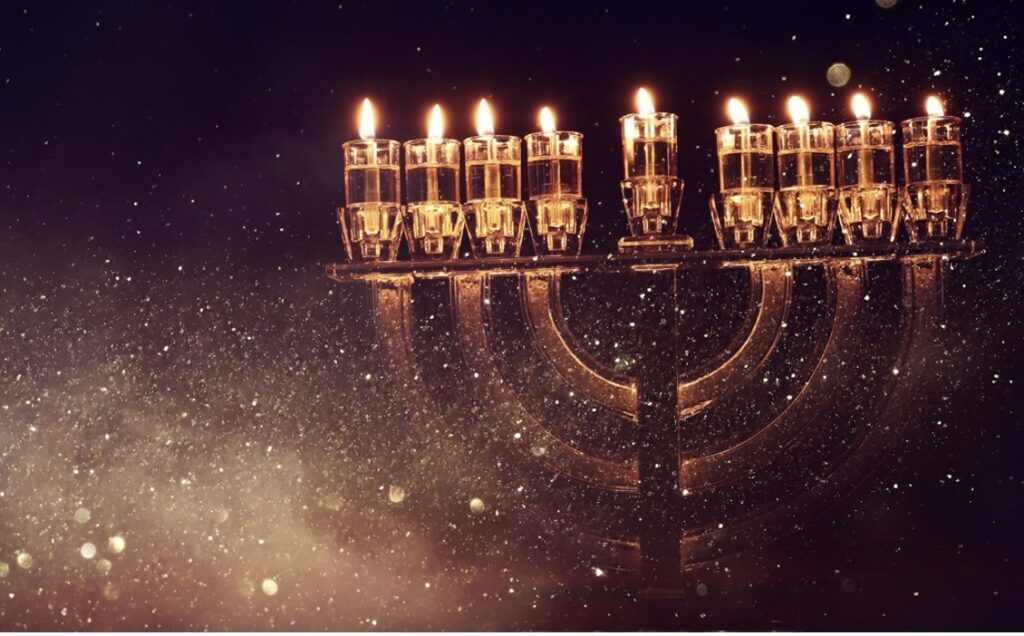
Now, people often have the question, why does this menorah have nine branches instead of seven, like the one in the temple? And the reason this has nine branches is because this is called a hanukkiah (חֲנֻכִּיָּה). This is a Hanukkah menorah that’s used only for the celebration of Hanukkah.
And it has nine branches because, well, let me just show you this old menorah I’ve had for so many years. You got four branches on this side, four on this side. And this middle one is called the shamish (שַׁמָּשׁ).
On each night, you put a candle in the shamish (שַׁמָּשׁ) and you light it. The word shamish means servant. Then on the first night of Hanukkah, we put a shamish candle, we put one candle over here at the end.
We light the shamish candle. We have a blessing that we say, we take the shamish candle, we light the first candle and put this one back. So we have the shamish and the first candle in the first night.
We let those burn down. The next night, we put a shamish, then we put two candles. We use the shamish to light these two.
The third night, we have the shamish and three candles. You can see we’re going through a lot of candles. I think it’s 44 in all.
If you go through the whole eight days of Hanukkah. But it’s wonderful to watch these candles that continue to grow and more light each night. And it’s a beautiful, beautiful celebration.
One that I highly recommend all of us as believers. I mean, after all, Hanukkah, the only place it’s mentioned in the Bible is in the Gospel of John. And we use this time to dedicate ourselves more to him, become a brighter light.
As an ancient tradition, I’ve been told that, and I’m not sure it’s true, but it’s a beautiful sentiment, that when Yeshua (יֵשׁוּעַ) says, I am the light of the world he said, I am the Shamash (שַׁמָּשׁ) of the world. In other words, we derive our light from him. He is the source of our light.
He is the servant of God. And he is the one who gives his light to us. After all, in Matthew 5, he says, I am the light of the world.
I’m sorry. Later on, he says, I am the light of the world. But then he says, you are the light of the world.
And he wants us to carry his light into the world and to share it. So I just wish you a very happy Hanukkah. And make it a time not just of food and parties and games and singing.
Make it a time of deep dedication to God. That each day your light might grow. And that with this, we help hurry the coming of Messiah.
And we just pray that he comes quickly and soon. We need him so much, especially in these last days. So be blessed and I wish you shalom and have a wonderful Hanukkah season.”
CLICK HERE to Print Notes and to View Images
Divine Appointments:
Hanukkah
חנוכה
Daniel 11:21, 29-31 And in [Seleucus IV’s] place a despicable person will arise, on whom the honor of kingship has not been conferred, but he will come in a time of tranquility and seize the kingdom by intrigue… At the appointed time, he will return and come into the South [Egypt], but this last time it will not turn out the way it did before. For ships of Kittim will come against him; therefore he will be disheartened and will return and become enraged at the holy covenant and take action; so he will come back and show regard for those who forsake the holy covenant. Armed forces will come at his order and profane the sanctuary and fortress. They will abolish the daily burnt offering and set up the abomination that causes desolation.
1Maccabees 1:20-25 After subduing Egypt, Antiochus returned in the one hundred forty-third year [=169 B.C.]. He went up against Israel and came to Jerusalem with a strong force. He arrogantly entered the sanctuary and took the golden altar, the lampstand for the light, and all its utensils. He took also the table for the bread of the Presence, the cups for drink offerings, the bowls, the golden censers, the curtain, the crowns, and the gold decoration on the front of the temple. He stripped it all off. He took the silver and the gold, and the costly vessels; he took also the hidden treasures that he found. Taking them all, he went into his own land. He shed much blood and spoke with great arrogance. Israel mourned deeply in every community…
1Maccabees 1:41-50 Then the king wrote to his whole kingdom that all should be one people, and that all should give up their particular customs. All the Gentiles accepted the command of the king. Many even from Israel gladly adopted his religion; they sacrificed to idols and profaned the Sabbath. And the king sent letters by messengers to Jerusalem and the towns of Judah; he directed them to follow customs strange to the land, to forbid burnt offerings and sacrifices and drink offerings in the sanctuary, to profane sabbaths and festivals, to defile the sanctuary and the priests, to build altars and sacred precincts and shrines for idols, to sacrifice swine and other unclean animals, and to leave their sons uncircumcised. They were to make themselves abominable by everything unclean and profane, so that they would forget the Law and change all the ordinances. He added, “And whoever does not obey the command of the king shall die.”
Antiochus’ Evil Decrees:
1Maccabees 1:54-64 Now on the fifteenth day of Kislev, in the one hundred forty-fifth year [=167 B.C.], they erected a desolating sacrilege on the altar of burnt offering. They also built altars in the surrounding towns of Judah and offered incense at the doors of the houses and in the streets. The books of the Law that they found they tore to pieces and burned with fire. Anyone found possessing the book of the covenant, or anyone who adhered to the Law, was condemned to death by decree of the king. They kept using violence against Israel, against those who were found month after month in the towns. On the twenty-fifth day of the month [Kislev] they offered sacrifice on the altar that was on top of the altar of burnt offering. According to the decree, they put to death the women who had their children circumcised, and their families and those who circumcised them; and they hung the infants from their mothers’ necks. But many in Israel stood firm and were resolved in their hearts not to eat unclean food. They chose to die rather than to be defiled by food or to profane the holy covenant; and they did die. Very great wrath came upon Israel.
Daniel 11:32-33 And by smooth words he will turn to godlessness those who act wickedly toward the covenant, but the people who know their God will display strength and take action. And those who have insight among the people will give understanding to the many; yet they will fall by sword and by flame, by captivity and by plunder, for many days.
1Maccabees 2:1-7 In those days Mattathias son of John son of Simeon, a priest of the family of Joarib, moved from Jerusalem and settled in Modein. He had five sons, John surnamed Gaddi, Simon called Thassi, Judas called Maccabeus, Eleazar called Avaran, and Jonathan called Apphus. He saw the blasphemies being committed in Judah and Jerusalem, and said, “Alas! Why was I born to see this, the ruin of my people, the ruin of the holy city, and to live there when it was given over to the enemy, the sanctuary given over to aliens?”
1Maccabees 4:36-51 Then Judah [Maccabee] and his brothers said, “See, our enemies are crushed; let us go up to cleanse the sanctuary and dedicate it.” So all the army assembled and went up to Mount Zion. There they saw the sanctuary desolate, the altar profaned, and the gates burned. In the courts they saw bushes sprung up as in a thicket, or as on one of the mountains. They saw also the chambers of the priests in ruins. Then they tore their clothes and mourned with great lamentation. They sprinkled themselves with ashes and fell face down on the ground. And when the signal was given with the trumpets, they cried out to Heaven. Then Judas detailed men to fight against those in the citadel until he had cleansed the sanctuary. He chose blameless priests devoted to the Law, and they cleansed the sanctuary and removed the defiled stones to an unclean place. They deliberated what to do about the altar of burnt offering, which had been profaned. And they thought it best to tear it down, so that it would not be a lasting shame to them that the Gentiles had defiled it. So they tore down the altar and stored the stones in a convenient place on the temple hill until a prophet should come to tell what to do with them. Then they took unhewn stones, as the law directs, and built a new altar like the former one. They also rebuilt the sanctuary and the interior of the temple and consecrated the courts. They made new holy vessels, and brought the lampstand, the altar of incense, and the table into the temple. Then they offered incense on the altar and lit the lamps on the lampstand, and these gave light in the temple. They placed the bread on the table and hung up the curtains. Thus they finished all the work they had undertaken.
25th of Kislev, 165 B.C. – the Temple rededicated
1 Maccabees 4:52-56 Early in the morning on the twenty-fifth day of the ninth month, which is the month of Kislev, in the one hundred forty-eighth year [164 B.C.], they rose and offered sacrifice, as the Law directs, on the new altar of burnt offering that they had built. At the very season and on the very day that the Gentiles had profaned it, it was dedicated with songs and harps and lutes and cymbals. All the people fell on their faces and worshiped and blessed Heaven, who had prospered them. So they celebrated the dedication of the altar for eight days and joyfully offered burnt offerings. They offered a sacrifice of well-being and a thanksgiving offering.
Megillat Antiochus (v.66-68) After this, the children of the Hasmonians came to the Temple, and they rebuilt the gates that had been destroyed and repaired the breaches, and purified … from the corpses and impurity. And they searched for extra-pure olive oil to light the Menorah, but only found one flask that was sealed with the signet ring of the High Priest, and they thus knew it was pure. And in it there was only enough oil to kindle for one day. And the God of Heaven, who causes His Name to rest there, gave a blessing in the oil, and they lit from it for eight days.
Q: Where did the Hasmoneans put the desecrated stones?
Talmud: Avodah Zarah 52b The northeastern chamber – within it the Hasmoneans concealed the stones of the altar that the Greeks had defiled when they seized control of the Temple. [+ Mishnah Middot 1.6]
Yeshua & Hanukkah
Five proofs of the Messiah:
John 10:22-33 Then came Hanukkah in Jerusalem. It was winter, and (a) Yeshua was walking around inside the Temple area, in Solomon’s Colonnade. So the Judeans surrounded Him and said to Him, “How much longer are you going to keep us in suspense? If You are the Messiah, tell us publicly!” Yeshua answered them, (b) “I have already told you, and you don’t trust Me. (c) The works I do in My Father’s name testify on My behalf, but the reason you don’t trust is that you are not included among My sheep. (d) My sheep listen to My voice, I recognize them, they follow Me, and I give them eternal life. They will absolutely never be destroyed, and no one will snatch them from My hands. My Father, who gave them to Me, is greater than all; and no one can snatch them from the Father’s hands. (e) I and the Father are one.” Once again, the Judeans picked up rocks in order to stone him. Yeshua answered them, “You have seen me do many good deeds that reflect the Father’s power; for which one of these deeds are you stoning me?” The Judeans replied, “We are not stoning you for any good deed, but for blasphemy- because you, who are only a man, are making yourself out to be God.”
Psalm 40:2 He brought me up out of the pit of destruction, out of the miry clay; And He set my feet upon a rock making my footsteps firm.
יון (yavan)
Hashem educates and prepares us for the awesome light that will be revealed in the times of Messiah by allowing us to experience sparks of that light each year on Hanukkah. (R’ Aryeh Strickoff)