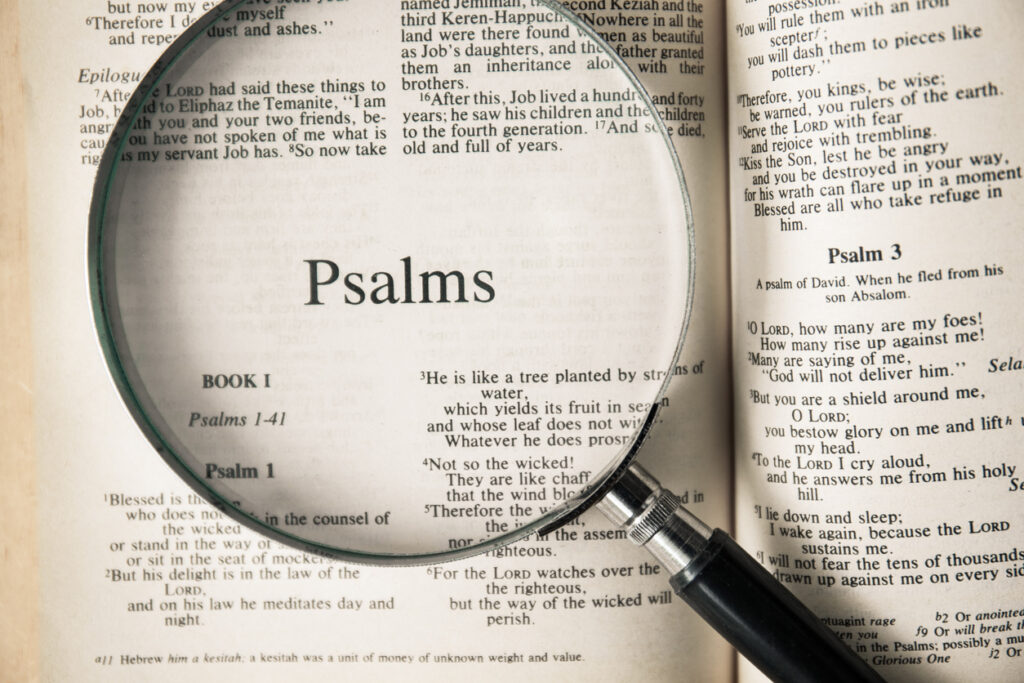

“Well, welcome, everyone, to Torah Today Ministries, as today we begin a new series called Tehillim Talks. Tehillim is the Hebrew word for Psalms. And we’re going to begin with Psalm 1.
As we work our way through, and I hope we can get all the way to Psalm 150, it’s going to be quite an ambitious project. But I’m really delighted and so looking forward to getting into these Psalms and doing just a patient and thorough study of them. The older I’ve gotten, the more I’ve appreciated the Book of Psalms.
I guess I had to get some years under my belt before I could really identify with the experiences that are described by David and the other psalmist who contributed to this book. And the Psalms talk about the highs and the lows of life. It talks about the joys of walking with God, of discovering things from his Torah, the joys of righteousness, but also the pain that’s caused by wickedness and by sin.
It talks about the grief of death and the joy of birth. It expresses the entire spectrum of human emotions. And it’s an amazing book, a wonderful book.
You can almost call the Book of Psalms the prayer book, the liturgical portion of the Bible. So I hope that as we go through these Psalms, they will find a place in your heart and a place in your prayers and a place in the way that you approach God, will give you words to express as you approach him.
Many people don’t realize that the Book of Psalms has traditionally been divided into five sections. And these five sections are named after the books of the Torah. So Psalms 1 through 41 are called the Genesis Book, Psalms 42 through 72, the Exodus Book, and so on. Your English Bibles may have these divisions marked in them. And again, they’re based on tradition.
But I enjoy going through each of these books of Psalms and looking for ways that they align with their corresponding book in the Torah. So you might enjoy doing that as well.”
“But as we get into Psalm number one, I want to point this out. Psalm 1 is very short. It’s only six verses.
And the first three verses are about the righteous man. And the last three verses are about the wicked man. It’s appropriate to start the Book of Psalms with this six-verse psalm, because the entire Book of Psalms expresses those two sentiments.
The joys of righteousness, the intimacy we experience with God, the joy of walking in His Torah, and the joy of discovering new things out of His Word. But the Psalms also describe the pain of sin, whether it’s sin in my own life or sin in someone else’s—the death and the stress and the persecution that comes from the wicked.
And then it talks about the conflict between these two, between righteousness and between wickedness—between light and darkness. And it also describes how light will win, how righteousness will win, and wickedness will be defeated.
So this first psalm sets a tone for the entire book. And you’ll notice this, I’m sure, as we go through these psalms.”
“Now, the first word of Psalm 1 is usually translated as blessed. But if we consult our Hebrew lexicons, we’ll find that the first word of Psalm 1, ashrei (אַשְׁרֵי), that you can see on the screen, doesn’t really mean ‘blessed.’
Ashrei means contented. It means happy.
‘Happy is the man, contented is the man who walks not in the counsel of the ungodly, nor stands in the way of sinners, nor sits in the seat of the scorner or the mocker.’
(Psalm 1:1)
Contented.
The word for blessed is the word baruch (בָּרוּךְ). And I think it’s worth pointing out that the word ashrei begins with the first letter of the Hebrew alphabet, which is aleph (א). But baruch begins with the second letter of the Hebrew alphabet, which is beit (ב).
I think the Creator may be trying to impress upon us that it’s not blessing that necessarily precedes contentment, but contentment precedes blessing. I have discovered that in my own life. And I know people who are blessed, but they are not contented.
And I think almost anyone who lives in America is blessed because of our freedoms and our prosperity. But a lot of people in America are not very contented. If we truly want to experience blessing in our lives, we need to learn to choose contentment.
And if we discover what it means to be ashrei, which starts with aleph, then we can really begin to experience blessing and enjoy blessing, which begins with beit.
The word ashrei is found throughout the Psalms.
‘Contented, or ashrei, are those whose way is blameless, who walk in the Torah of Adonai. Ashrei, contented, are those who keep his testimonies, who seek him with their whole heart.’
(Psalm 119:1–2)
Ashrei is also the very first word of the Sermon on the Mount. In Matthew 5, Yeshua sits down and he teaches the crowds, and he teaches them in chapters 5, 6 and 7. But the first word that comes out of his mouth is the word ashrei.
Now our English translations will say:
‘Blessed is the poor in spirit, for theirs is the kingdom of heaven.’
(Matthew 5:3)
But Messiah would have said ashrei, contented. That is the word that lies behind the Greek word. And each of the Beatitudes begins with this word: contented, ashrei.”
“Now, in that first verse, notice the progression.
‘Contented is the man who walks not in the counsel of the wicked, nor stands in the way of sinners, nor sits in the seat of the scoffers.’
(Psalm 1:1)
So think of a person who does walk in the counsel of the wicked. And then it says, ‘nor stands.’ So the walking stops—he stands. He decides where he’s going to stand. He stands in the way of sinners. ‘Nor sits in the seat of the scoffers.’
So you have walk, stand, sit.
The man who walks in the counsel of the wicked, then stands in the way of sinners, and then sits in the seat of the scoffers, is going to be a miserable individual. They will not experience contentedness in their life.
But contented is the man who walks not in the counsel of the wicked, nor stands in the way of sinners, nor sits in the seat of scoffers.”
“But his delight is in the Torah of Adonai.
‘His delight is in the Torah of Adonai, and on his Torah he meditates day and night.’
(Psalm 1:2)
That word for delight is one of my favorite words in Hebrew. It’s the word chafeitz (חָפֵץ). Chafeitz means to delight, to take pleasure in.
‘I chafeitz, I delight to do your will, O my God; your Torah is within my heart.’
(Psalm 40:8)
My mother was never a very materialistic person. And people wondered why she was always so happy when she didn’t surround herself with a lot of stuff. And she would say, ‘Well, I have everything I want, but I know what to want.’
And when we know what to want, and we’re told here in the Psalms that the one who delights in the Torah of Adonai—we must learn to delight in God’s Torah. And in Psalm 40 verse 8, we must learn to delight to do God’s will.
The deepest joys we can ever experience is doing the things God has given us to do—doing them for Him. Because then we’re doing what we were created to do. Paul tells us that we were created in Messiah Yeshua for good works. And when we do those good works we’re created to do, we’re fulfilling our destiny. We’re doing what we’re meant to do with our lives.
There’s no higher joy. There’s no greater delight than doing that.”
“There was a Jewish rabbi who lived in the last century. And I happen to have his book here on the shelf. And his name was Rabbi Meir, but they called him the Chofetz Chaim (חָפֵץ חַיִּים). And I highly recommend his books. And this is a really good one, The Daily Companion.
The Chofetz Chaim believed that the secret to really enjoying God and living a righteous life is controlling the mouth and not speaking lashon hara, evil speech. And so he wrote extensively about this. You might not think there is that much to write, but when you begin to tap into his writings, you begin to realize just what a vast and important subject this is.
How did he get the name Chofetz Chaim? Well, it comes from another Psalm.
In Psalm 34 verses 12 and 13, there’s a question that’s asked, and then the question is answered. The question is this:
‘Who is the man who chofetz chaim, who desires life, and loves length of days that he may see good?’
(Psalm 34:12)
Do you desire life? I know I do. So the psalmist is asking, ‘Who is the man who chofetz chaim, who desires life, and loves length of days that he may see good?’
Here’s the answer to how you get that:
‘Keep your tongue from evil and your lips from speaking deceit.’
(Psalm 34:13)
Because the Chofetz Chaim, Rabbi Meir, wrote so extensively about this, he just got the name Chofetz Chaim, and that’s how he is known even today.”
“Jeremiah—so let me back up for a moment. Let’s get back to Psalm number one.
‘So, contented is the man that does not walk in the counsel of the wicked, nor stand in the way of sinners, nor sit in the seat of the scoffers, but his delight, his chafeitz, is in the Torah of Adonai. And on his Torah he meditates day and night.’
(Psalm 1:1–2)
I want to look at that word meditate. That word meditate in Hebrew is the word hagah (הָגָה), hagah.
And what’s interesting about this word in Hebrew is—the language of transcendence—it’s amazing how every jot and tittle of Hebrew has meaning. That’s what the Master tells us. And so the shapes of the letters, the spellings of the words, all have emphasis and meaning to us.
And this word for meditate in Hebrew is not the kind of meditation we hear so much about today in Eastern mysticism and Eastern meditation where you try to clear your mind and think about nothing. That is not biblical meditation.
Biblical meditation is where you meditate on something. You meditate on what is righteous, what is good, and what is true.
And when you look at this word hagah, you’ll notice that’s a palindrome. It’s spelled the same forward as backward. It’s spelled hey–gimel–hey (ה–ג–ה), and if you spell it backwards, it’s hey–gimel–hey.
When we meditate, two things happen. We begin to draw close to God, but he draws close to us. It’s almost like an image in a mirror. As you come close to the mirror, the image draws closer to you. It’s hagah, and this is what meditation does. It’s a way for us to begin to align our lives more closely with God, draw near to him in that way.
That gimel (ג) in the middle of the word is supposed to be a picture of a man walking. You can see him stepping out and he’s moving from right to left. It’s actually a picture of a person moving from one hey (ה) to the other hey. It’s a very spiritual word.
But another thing I have to point out is this: the word hagah has numerical value of 13. Hey is five, gimel is three, and the other hey is five, so it equals 13.
And 13 is also the numerical value of echad (אֶחָד), which means one.
‘Hear, O Israel, the Lord our God, the Lord is one (echad).’
(Deuteronomy 6:4)
It’s also the numerical value of the word ahavah (אַהֲבָה), which means love.
‘We are to love the Lord our God with all our heart, our soul, and our strength.’
(Deuteronomy 6:5)
Ahavah and one both have a numerical value of 13. Because when you truly love another and that other loves you, you become one.
Hagah—meditating on God’s word—is a way of experiencing true unity with God. But that meditation must be done out of love for him. Not that you’re trying to get something out of him, but because you truly want to draw close.
When you love someone, you want to be with them. And meditation—meditation that is prayerful and focused on God’s truth and upon God’s words, attributes, and characteristics and accomplishments—that is the way we begin to experience real intimacy with him.”
“As we go through Psalm 1 and verse 3, we read that
‘He is like a tree planted by streams of water that yields its fruit in its season, and its leaf does not wither. In all that he does, he prospers.’
(Psalm 1:3)
The righteous man is like a tree that is planted. He’s not a wild tree. He’s a tree that has been planted. And where has he been planted? By streams of water. So when the rest of the land is experiencing drought, this man experiences riches from the depths. He has a rich and strong root system.
Jeremiah also shares this same sentiment:
‘He is like a tree planted by water that sends out its roots by the stream and does not fear when heat comes, for its leaves remain green, and it is not anxious in the year of drought, for it does not cease to bear fruit.’
(Jeremiah 17:8)
I have a feeling Jeremiah was writing this based upon Psalm 1. He would have known the Psalms intimately. And so he takes this third verse of Psalm 1, and then he rewords it and opens it up and elaborates on it more in a very beautiful way.”
“Now it says there at the end of verse 3,
‘In all that he does, he prospers.’
(Psalm 1:3)
There is a lot of talk in the redeemed community today about prosperity, and “if you’re living a life of faith, you’re going to be prosperous, you’re going to be wealthy,” and we call this the name-it, claim-it movement. And I am not a proponent of this movement. I think it’s very dangerous and has seriously damaged the faith of many.
But the word that is used there at the end of verse three is the word tzalach (צָלַח), tzalach. And what the word tzalach means is not so much ‘prosperity,’ even though some English translations will translate verse three with ‘prosperity’—that is not really the meaning of the word.
It means to bring to a successful conclusion or to accomplish a mission.
The first four times you find this word is in Genesis chapter 24. And if you look up Genesis 24 in your Bible, you’ll notice it’s the story about Abraham sending his servant Eliezer to go back to Abraham’s home country to find a bride for his son Isaac. And so whenever Eliezer is referring to his journey and how he accomplished his mission, the word tzalach is the word that’s used.
So tzalach is something that we are very much involved in, because all of us are on a journey. All of us have a mission, and we need to walk out our journey. We need to be faithful. We need to do what God asks us to do. And this kind of righteous person who is faithful to his mission—he’ll experience tzalach. He will accomplish the mission.”
“We’ll find this word also in Joshua 1:8. In fact, two of the words we’ve just discussed are in this passage. The angel tells Joshua:
‘This book of the Torah shall not depart from your mouth, but you shall hagah—you shall meditate on it day and night—so that you may be careful to do according to all that is written in it, for then you will make your way successful (tzalach), and then you will prosper.’
(Joshua 1:8)
And it’s talking about what? It’s talking about the way, the mission, the journey. You’ll have a good outcome. You’ll accomplish your goal.
And then you will prosper. Now that’s the word we have to be careful of there. That’s a different word. And some English translations switch these definitions: ‘you’ll make your way prosperous and then you’ll have success.’ I don’t think that’s as good a translation as this one here.
This word prosper is first found in Genesis chapter 3—and I think it’s verse 6. It’s when the serpent comes and tempts Adam and Eve. And he tells them that they should eat of this fruit, this fruit of this tree. And it says that they saw that the fruit was attractive to the eyes, it was good for food, and desired to make one sechal (שֵׂכֶל)—sechal—that’s the word used here.
Sechal means to be clever. It means to prosper, to satisfy my desires, to get the things I want.
So the first time we find this word, it’s used in a very negative, negative sense.
When I look at these two words, the word tzalach, ‘successful,’ and the word sechal, which is ‘prosper,’ I think of it this way: this word, tzalach, is the one that depends on us being faithful, following God’s path, accomplishing our purpose in life. And if we do that, then God will give us this.
But if we pursue this first—sechal first—we may never experience tzalach.
Tzalach must precede sechal.
So this is why Joshua is told: ‘For then you will make your way tzalach, and then you’ll have sechal. Then you’ll have that added on.’
So we need to get our priorities right. Of course, who doesn’t like prosperity? Who doesn’t like riches and wealth? Everybody does. But when we pursue that, we may miss our life mission. But if we pursue our life mission, not only will we accomplish it, but everything else is added on.
It’s as the Master said:
‘Seek first the kingdom of God and His righteousness, and all these things will be added unto you.’
(Matthew 6:33)
So those first three verses of Psalm 1 tell us about the righteous man. And I hope that I’ve helped it sound as attractive as it really is. There’s no better way to live. And when we stray away from living the righteous life, oh my goodness, do things get miserable then.”
“So let’s continue. In verses four and five it says:
‘The wicked are not so, but are like the chaff that the wind drives away. Therefore the wicked will not stand in the judgment, nor sinners in the congregation of the righteous.’
(Psalm 1:4–5)
‘The wicked are not so.’ Not so is what? Well, they’re not like a tree planted by streams of water that yields its fruit in its season and whose leaf does not wither and that in all he does he prospers. The wicked aren’t like that.
What are they like? They’re like the chaff that the wind drives away. If there’s anything in the plant world that’s more different from a tree, it’s got to be the chaff—this dead stuff, this husk that’s around the grain that is just blown away by the wind. It has no use whatsoever.
It says they’re like the chaff that the wind drives away. Therefore the wicked will not stand in the judgment, nor sinners in the congregation of the righteous.”
“I want to show you something that I find fascinating. This is the Hebrew letter tzadi (צ). And it has two forms. The form on the right is the way it appears at the beginning of a word or inside of a word. But whenever tzadi occurs at the end of a word, it changes shape. It becomes this form, this final form.
Now, the rabbis tell us that tzadi images a man who is kneeling. You can see his knees here—he’s kneeling towards the right. And he has his hands in the air. So he’s in a position of humility while he has his hands up, praising God.
And we know that the right is always the spiritual; the left is the physical. So he’s kneeling to the spiritual, to the right, towards God, who is Spirit. His hands are raised in praise, but he’s in a position of humility.
But when tzadi comes at the end of a word, it stands up. Because in the end of time, at the judgment, the righteous will stand. But notice he’s still in the position of praise, but now he’s standing up. This is the life of the righteous person.
But the wicked person—they will not stand in the judgment.
A righteous person is called a tzaddik (צַדִּיק), and that comes from this letter tzadi. The letter tzadi means ‘righteous.’ A tzaddik is a righteous person.”
“In Matthew 7, another part of the Sermon on the Mount, Messiah says something that has been troubling to a lot of people and it can be a little confusing. He says:
‘Not everyone who says to me, “Master, Master,” will enter the kingdom of heaven, but the one who does the will of my Father who is in heaven. On that day many will say to me, “Master, Master, did we not prophesy in your name, and cast out demons in your name, and do many mighty works in your name?” And then I will declare to them, “I never knew you; depart from me, you workers of lawlessness.”’
(Matthew 7:21–23)
Whenever the Scriptures use the word lawlessness, it’s not Roman law, it’s not Greek law it’s concerned with—it’s God’s law, God’s Torah. So when the Messiah refers to lawlessness, it’s Torahlessness—it’s living apart from God’s commandments.
But what does it mean when he says, ‘I never knew you’? I mean, doesn’t he know all things?
We must understand that in the Hebraic mindset, to know something means more than just to have information. Messiah is not talking here about not having information. He has the information.
But to know something means to be one with it, as it describes in Genesis, where Adam knew his wife, and she then conceived and gave birth. And later Abraham knew his wife—they became one, and then she conceived.
To know someone or to know something is to be one with it. The rabbis often say that the knower and the knowledge must become one.
This exposes the danger of just having theology and knowing stuff, but not allowing it to impact how we actually think, make decisions, and walk out this life.
Just having theology in your head doesn’t really accomplish much. Satan and the demons all have perfect theology. They know theology better than you or I do. It sure doesn’t impact their lives, does it? In fact, it says that the demons, they tremble, you know? They understand what’s going to happen. It causes them to tremble.
But how many of us, with all of our theology, actually tremble? We actually have an awe of God that affects the way we live in this life?
So having demonic thinking, where we think theology is all that matters—that’s not going to accomplish it. We need to be one with the Theos, with the God about whom we have theology. Because to know about Him is one thing, but to know Him, to be one with Him, to be united with Him—that is what really, truly matters.”
“Paul brings this out in 1 Corinthians 8. He says:
‘But if anyone loves God, he is known by God.’
(1 Corinthians 8:3)
God has all the information. But until you truly love God and surrender your life to Him, you’re not really one with Him. And that’s what Paul is talking about here.”
“So let’s finish our psalm:
‘For Adonai knows the way of the righteous, but the way of the wicked will perish.’
(Psalm 1:6)
Now, if you pay close attention, there are two words there that echo back to verse 1. See if you can catch them. In verse 1 it says:
‘Contented is the man who walks not in the counsel of the wicked, nor stands in the way of sinners…’
(Psalm 1:1)
We find that word way and the word wicked in this verse, this last verse as well:
‘For Adonai knows the way (derech) of the righteous, but the way (derech) of the rasha, the wicked, will perish.’
(Psalm 1:6)”
“The theme verse for my life and for the congregation that I oversaw for a quarter century—Beth Tekun Messianic Fellowship—comes from Psalms. So now I want to close this teaching with this verse. And we may refer back to it frequently as we go through our Tehillim Talks.
‘I long for your Yeshua, Adonai, and your Torah is my delight.’
(Psalm 119:174)
In most English translations, it’s going to say ‘salvation,’ because Yeshua’s name means salvation. The angel appeared to Joseph, and before Yeshua’s birth, he told Joseph:
‘You shall call his name Yeshua, because he will yoshia his people from their sins.’
(Matthew 1:21)
You’ll call him ‘Salvation,’ because he will ‘save.’ Yeshua’s name means ‘salvation.’ Salvation is Yeshua. So I translate the word in the name of my Savior—I translate it Yeshua:
‘I long for Yeshua, Adonai, and how I long to see his day when he returns. In the meantime, your Torah is my delight.’
(Psalm 119:174)
The word ‘delight’ here is not chafeitz. It’s the word sha’ashu’im (שַׁעֲשׁוּעִים), and it’s a word we’ll look into later on in another psalm. But I think the psalmist David picked this word because it sounds like Yeshua:
‘I long for your Yeshua, and your Torah is my sha’ashu’im.’
So there is no conflict between having Yeshua as our Master, our Rabbi, our Savior, and pursuing the Torah and the righteousness that we experience as we yield our lives to God’s commandments.
It’s not that Yeshua came to do away with the Torah—not at all. He says, ‘Don’t even think that.’ But we long for the day of Yeshua to come, and in the meantime, let us be occupied with God’s Torah.”
“And as we do, I encourage you to pray the Psalms, to build them into your lives, and to make them the corrective lenses through which you look out at life and you see what is right and what is wrong, what is pleasing to God, what is displeasing.
And not only that, you can look into yourselves and you can reveal the things in your own life that need to change, that need to go, and build into your life those things of righteousness that will make you resemble Yeshua more.
So God bless you. I look forward to seeing you back as we then look into Psalm number 2.
So until then, I wish you shalom. And if you have questions or comments, please click on the link below the video, and I’d love to hear from you.
So God bless, and I’ll see you next time.”
The Five Books of Psalms
אשרי (ashrei) = “contented”
Psalm 119:1-2 – Contented are those whose way is blameless, who walk in the Torah of Adonai! Contented are those who keep His testimonies, who seek Him with their whole heart.
חפץ (chophetz) = “delight/take pleasure in”
Psalm 40:8 – I delight to do Your will, O my God. Your Torah is within my heart.
Psalm 34:12-13 – [Q:] Who is the man who desires life and loves length of days that he may see good? [A:] Keep your tongue from evil, and your lips from speaking deceit.
הגה (hagah) = “meditate”
Jeremiah 17:8 – He is like a tree planted by water, that sends out its roots by the stream, and does not fear when heat comes, for its leaves remain green, and is not anxious in the year of drought, for it does not cease to bear fruit.
צלח (tzalach) = “bring to a successful conclusion”
Joshua 1:8 – This Book of the Torah shall not depart from your mouth, but you shall meditate on it day and night, so that you may be careful to do according to all that is written in it. For then you will make your way successful, and then you will prosper.
צ / ץ (tzaddi)
צדיק (tzaddik) = “righteous person”
Matthew 7:21-23 – “Not everyone who says to Me, ‘Master, Master,’ will enter the kingdom of heaven, but the one who does the will of My Father who is in heaven. On that day many will say to Me, ‘Master, Master, did we not prophesy in Your name, and cast out demons in Your name, and do many mighty works in Your name?’ And then will I declare to them, ‘I never knew you. Depart from Me, you workers of Torah-less-ness.’”
1 Corinthians 8:3 – But if anyone loves God, he is known by God.
Psalm 119:174 – I long for your Yeshua, Adonai, and Your Torah is my delight [sha’ashuim].