Introduction
Tabernacle Study Pt. 1
Welcome to Torah Today Ministries and a new series on the Tabernacle — a series I’m calling “Enter In.” I presented this series back in the spring of 2025 in Kathu, South Africa. And it was a wonderful time with a wonderful congregation of people. The recording of that series, however, had some problems — some technical issues. And so I’m redoing it here. I’m expanding it, bringing some more detail, some deeper insights. I’m kind of glad I’m redoing the series. So I hope you enjoy this first episode of the Tabernacle.
Now, let me share something with you that you have to get hold of. If you’re watching this series, it must mean you’ve had some curiosity about the Tabernacle. Well, that’s good. I believe God’s spirit is the one who brought you to this and stirred that curiosity within you — because there is no single topic in the Bible that gets more press, more real estate and coverage, than the topic of the Tabernacle and the Temple, which is built on the same basic model. In fact, the Tabernacle is described seven times just in the book of Exodus. It is an incredibly detailed thing — a structure that is very close and dear to God’s heart. But unfortunately, it’s not that dear and close to the heart of many of his followers.
Why is the Tabernacle so important? Well, the way I describe it is this. If you’re reading a history book or a biography — I’m reading a biography on Teddy Roosevelt right now — and right in the middle of the book, you come to these glossy pages that have photographs of him when he was a child and of his parents, his family, his friends, and historical events in his life. You have this illustration section in the middle of the book.
Well, think of the Tabernacle — the description of the Tabernacle in the Torah — as God’s illustration section for the Bible. Because I’m telling you right now, anything and everything the Bible has to teach is illustrated somehow in the Tabernacle. It is the illustration section of the Bible. And the more familiar we can become with the Tabernacle — with all of its details, with its materials, with its proportions, with its description — the more we’re going to equip our souls to grapple with the subjects and the principles that the Bible wants to teach us.
So, as we go through the Tabernacle, we’re going to unfold it a bit at a time. And this first introductory section is going to be taken from Exodus 25:1–9. And there are some very important words and concepts here that you don’t want to skip over.
Now here is a bird’s-eye view of the Tabernacle. The tent part here inside the courtyard has been cut away so we can see the inside. The Tabernacle’s entrance was always to the east. And you would come in, you would see the bronze altar and then the bronze laver. And anyone could come into the outer court — Jew, Gentile, made no difference. But then this large part under the tent canopy is called the holy place. And only the priests were allowed to enter there. And there you would find the golden menorah (מְנוֹרָה), the table of showbread, and the golden altar of incense. And then through this curtain right here, the high priest would enter only once a year on the day of Yom Kippur (יוֹם כִּפּוּר) into the Holy of Holies.
So those are the three main parts of the Tabernacle: the outer court, the holy place, the Holy of Holies. And by the time we finish this series, you’re going to be intimately familiar with each of these areas and its details.
Now, there are three major themes that I want us to lay hold of in the study of the Tabernacle. Keep these three themes in mind all at the same time if you can.
Number one, the Tabernacle is a picture of Yeshua (יֵשׁוּעַ). And John realized this, because in John 1:14 he said:
“And the word became flesh and “tented” among us. We have seen his glory, glory as of the only Son from the Father, full of grace and truth.” — John 1:14
Your translation probably says “dwelt among us.” But the Greek word for “dwelt” is skēnoō (σκηνόω) — and it comes from the word skēnos (σκῆνος). Skēnos is a tent. In fact, we get our English word “skin” from skēnos because tents were made usually from skin. So skēnos — skin — is a tent. Skēnoō means “to have one’s tent.” This is the word that John used in his Gospel in chapter 1, verse 14. So the word became flesh and tented among us.
So the Tabernacle is a picture of Yeshua himself dwelling among us. Now how could this be? Well, when we look at how the Tabernacle traveled — when we look at how the Tabernacle was very plain and very unattractive on the outside but filled with the very glory of God on the inside — we get an idea a little bit more of Yeshua. And the prophet tells us:
“There is nothing beautiful or becoming about his appearance that we would be attracted to him.”
Saying “oh what a good looking guy”,He wasn’t like King Saul, who was head and shoulders above everybody else and was this handsome man everyone was drawn to. In fact, I wouldn’t be surprised if Yeshua was fairly short — I don’t know. But he didn’t attract people because of his good looks. He was not a movie-star-like character. People were attracted to him because of his soul, because of who he was — not because of the outside. We’ll see a little bit more about this as we go further. So, first of all, the Tabernacle is a picture of Yeshua, of Messiah dwelling among us.
But the Tabernacle is also a schematic of us — of you, of me. After all, we are to be disciples of Yeshua. We are to be modeled after him. Yeshua perfectly bore the image of God. We too are to bear the image of God. So the more like Yeshua we become, the more in God’s image we become, the more human we become, the more you — you — become. And this is some of the most important teaching and insight that you can discover as you study the Tabernacle. It’s a picture, a schematic of you.
Now, if you’re not familiar with the word “schematic” — it’s a term that if you’ve dabbled in electronics or plumbing or any kind of a technical field, you’re familiar with. A schematic gives the scheme of something. A schematic is not a photograph of something, but it gives the logical scheme of how something works. I mean, after all, the Tabernacle had a dirt floor, it was rectangular, and is about so tall. That’s not a picture of us. But the scheme — what it lays out, the logics that it presents — those things are a picture of you and me.
For example, let’s go back to our picture of the Tabernacle. It has an outer court. It has this area here that is open to the sun, the moon, the wind, the rain, snow if they got snow. This is like our body. This is the first thing people encounter when they meet us. They see our face, they see our height, maybe see our weight, how we dress. And they can tell things about us just by our physical appearance. So the outer court is like the human body. And just as the outer court was subject to all the wears and tears of the weather and the physical world, so are our bodies. And the outer court was simply made of fabric hanging on these posts — it wasn’t all that tough. If somebody got a running start and went fast enough, they could probably just rip right through the side of it. And our bodies are rather frail.
But inside the outer court there is the holy place and Holy of Holies. These are the parts that were very tough, very strong — made out of large timbers covered with gold. If you tried to run through the wall of this, you would just bruise yourself up. And the soul and the spirit are pictured by the holy place and the Holy of Holies. God’s spirit would dwell here in the Holy of Holies, and he wants his spirit, his essence, to dwell in your spirit.
But the connecting part between the spirit and the body was the holy place — which is the soul. You are a soul, but you have a spirit and you have a body. The spirit is the more internal part of you. Your body is the external part of you. So there is just a little overview of what we will be going over later.
Paul makes this clear in 1 Corinthians 6:19:
“Do you not know that your body is a temple of the Holy Spirit within you, which you have from God?” — 1 Corinthians 6:19
And also Paul over in 1 Thessalonians 5:23 gives us a little more detail:
“Now may the God of peace himself sanctify you completely, and may your whole spirit and soul and body be kept blameless to the coming of our master Yeshua, the Messiah.” — 1 Thessalonians 5:23
Spirit, soul, body. Notice he starts from the inside and then soul and then goes to the outside — body. As we read our description of the Tabernacle in the next episode, you’ll see that that is exactly how God describes the Tabernacle to Moses — beginning with the inside and working to the outside.
So, first theme: the Tabernacle is a picture of Yeshua. Second: it’s a schematic of us. But third, the Tabernacle illustrates the intimacy between God and his bride. If we’re a disciple of Yeshua, then we’re part of God’s bride. And God wants to dwell intimately with his bride. And in the Tabernacle is where God and man could meet. When the high priest would go into the Holy of Holies once on Yom Kippur, there he was — a man — right there before the glorious presence of God himself.
And the Tabernacle is also a picture of how God is restoring Eden to earth. You know, when Adam and Eve sinned, they were driven out to the east — driven out from the Garden to the east. Well, the entrance of the Tabernacle is on the east. That’s how you came in. And they were driven out because they were not permitted access to the tree of life. But what was in the Holy of Holies? The ark of the covenant. And there, either inside the ark or beside it, the Torah tells us they put a copy of the Torah. And what does Solomon tell us? That the Torah is a tree of life to all those who grasp it. Solomon several times in Proverbs speaks about God’s word and his wisdom being a tree of life. So in the Tabernacle, man again has access to the tree of life.
But remember — in the Garden of Eden, God stationed two cherubim (כְּרוּבִים) in front of the entrance to the Garden to keep man from coming back in. And on the curtain — the parochet (פָּרֹכֶת) — that separated the Holy of Holies from the holy place, there were embroidered cherubim. They once again were guarding the entrance into the Holy of Holies. Well, what happened when Yeshua was crucified? It tells us that that parochet, that veil, was torn in two from top to bottom — as if the cherubim were stepping aside and saying, “The entrance into the tree of life is once again open to you.”
I’m getting a little ahead of myself, but I want to whet your appetite for the beautiful insights that are contained in this model of the Tabernacle. So, let’s get right into it. But remember these three themes: a picture of Messiah, a schematic of us, and how the two come together.
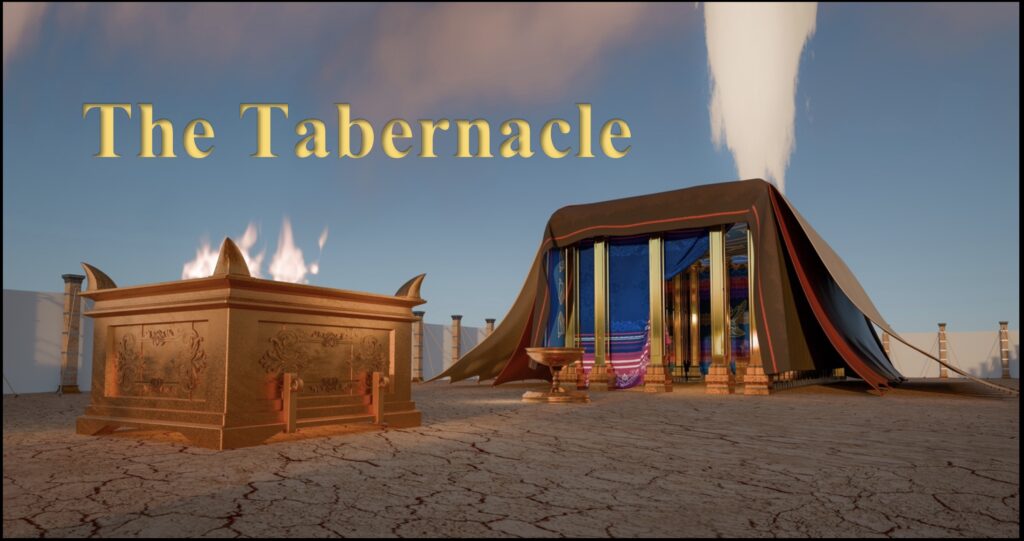
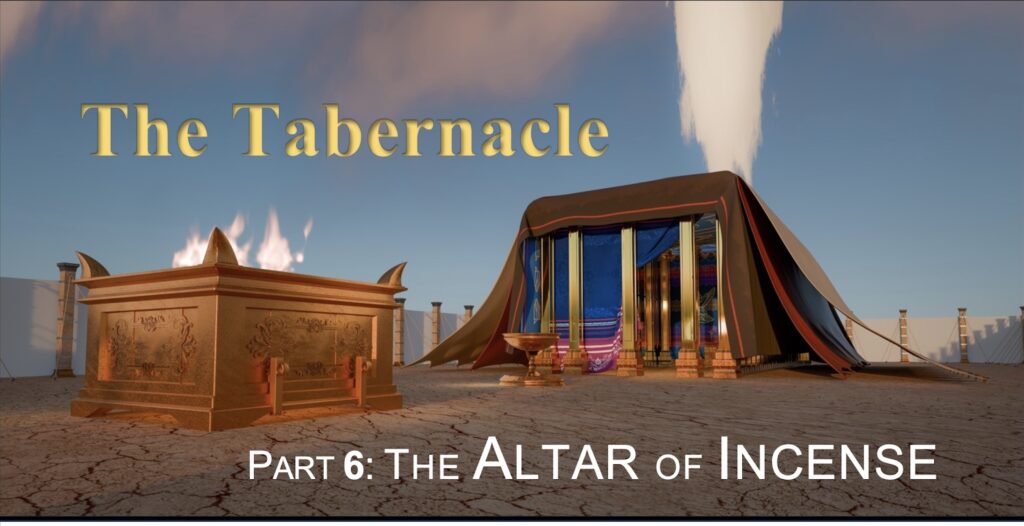
Now, here’s an artist rendering of what it might have looked like to stand in the outer court. And here on the left, you can see the large bronze altar, and you see some fire on top. The bronze laver is right there. And then you get a little bit of a look at the curtain here that separated between the holy place and the outer court. And if you went on in and further in, you would go to the Holy of Holies. And you can see a little bit of the curtains around the outside of the outer court. And I’ll be sharing a number of illustrations with you in this. So, if you are listening to this teaching while you’re driving the car or washing dishes or whatever, please, please, please be sure to go to our website at TorahTodayMinistries.org. Click on the teaching and then you can print out all the notes in full color with the Hebrew and with the references and everything else. And you can have this to look at and to reference as you review the teaching later.
Now, speaking of schematics, this is the most accurate schematic I’ve come up with for the Tabernacle. You can see that the Tabernacle’s length is twice its width — the outer court, that is. And the entrance was just a partition and you went around the edge of it to go into the outer court. So, it’s two squares side by side. And in the middle of the first square is the bronze altar. And then past that is the bronze laver. From there you could go in — if you were a priest — into the holy place. To your right on the north side of the holy place would be the table of showbread. And we’ll be seeing that in great detail later. And then on the south side to your left would be the golden menorah. And straight ahead in front of you would be the golden altar of incense. And if you were a priest, that’s as far as you would go, because there was a curtain here called the parochet — the veil. And as I mentioned a couple of times already, only the high priest could go through the veil to where the ark of the covenant rested in the middle of the Holy of Holies. The Holy of Holies was a perfect cube. Its width, its length, and its height were all identical.
And remember that this outer court is an illustration, a schematic that represents the human body. This holy place represents the soul. And this smaller area — this cube — represents the spirit.
Now remember: you are a soul. You do not have a soul. You are one. And as a soul, you have a body. And just as the soul can either focus on what is out here in the physical, or it can focus on what is in here in the spiritual — the holy place had two entrances or exits, whichever you want to call them. From the holy place, you could go east out to the outer court. You could go west into the Holy of Holies. As a soul, I am always confronted with this same decision.
I can focus on things on the right — and you know, in the scriptures, the right is always the spiritual and the left is always the physical. And you might think, well, why is the Holy of Holies on the left side? Well, we’ll get to that later. I’m just laying this out as it’s traditionally done, but we’ll learn some things about this layout in future installments of this series.
But as a soul, I can always go out to the outer court. I can go in to the Holy of Holies. And each day I need to learn to do both. We need to spend time in the world doing the things that we need to do — to do work, to interact with other people, to spend time accomplishing things, making a change in the world. But if we don’t spend time in the Holy of Holies — just me, alone with my Creator, with my Savior — then we’re not going to be equipped to go in the world and do the work we need to do. So the soul is the place where the two come together, where the spiritual and the physical come together.
And I’m just giving you the basics right now. And again, I keep saying this, I apologize, but we’ll be seeing this in greater detail in future episodes.
Now, let’s go to Exodus 25, verses 1–7. Adonai said to Moses:
“Speak to the children of Israel that they take for me a terumah (תְּרוּמָה) — from every man whose heart motivates him, you shall take my terumah. And this is the terumah that you shall receive from them: gold, silver and bronze; blue and purple and scarlet yarns, and fine twined linen; goat’s hair; red-dyed ram skins; tachash (תַּחַשׁ) skins; acacia wood; oil for the lamps; spices for the anointing oil and for the fragrant incense; shoham (שֹׁהַם) stones and stones for setting for the ephod and for the breastplate.” — Exodus 25:1–7
Notice it wasn’t a demand that everybody must give something. The ones whose hearts move them. Now, right there is a lesson. We are in the process of becoming the people we should be. There’s a legend that when God said “let us make man in our image,” he was talking to Adam: “Adam, let us — you and me together as partners — make you into my image.” In other words, it’s a cooperative effort between us and God. He will always do his part, but he will not do ours. We have responsibilities that he’s counted upon us to fulfill.
So for every man whose heart motivates him, God wants a willing heart. He wants people whose hearts are motivated to build his image more into themselves — to become the man, the woman that he wants us to be.
As mentioned, terumah means a contribution or an offering. And the root of this word is the word rum (רוּם) — take the three middle letters resh-vav-mem (רום). Rum means to uplift or to exalt.
Think about this for a moment. Where did all the raw materials for the Tabernacle come from? If you think for a moment, you realize they all came from Egypt. It was only about seven weeks earlier that Israel had come out of Egypt, crossed the Red Sea, traveled through the wilderness, come to Sinai, and now Moses is on Mount Sinai and God is downloading this information to him. So all the things they had came out of Egypt.
When we come out of Egypt — when we come out of a life of sin, when we repent and come from slavery to freedom and from death to life through the body and blood of the lamb — we bring a lot of stuff with us. And God says: “Yield it to me. Exalt it and lift it up to me. Give it to me if your heart’s willing. Give it to me. And together, as you submit it to my plan, we can make it into a place where we can dwell together.”
Think of it this way. All of us are in the process of building a home where God can live fully and completely in us. We’re all in the process of refining and making our lives more into the image of what God wants them to be. And we do this with a willing heart as we take the materials — the strength, the time, the possessions, the talents, the gifts, the finances, whatever we have — and we, with a willing heart, say, “Father, they’re yours.”
The plan for the Tabernacle came from God and was given to Moses on Mount Sinai. But the raw materials for the Tabernacle came out of Egypt — the people had those. So when they elevated those raw materials to God’s plan, a Tabernacle results. God makes a home with us. God is asking us: if your heart is willing, take the things from your past. Give them to me. Yield them, submit them to my will, to my plan, to my Torah (תּוֹרָה). And you’re going to find intimacy with me. You’re going to find me dwelling in the midst of your life in a way you never dreamed possible. That is the very heart and essence of what the Tabernacle teaching is all about.
Now, if you counted the number of raw materials listed, you notice that there were 15. What’s the significance of 15? There are certain numbers in the Bible repeated over and over — the number 40, the number 7, the number 10. And there are some other numbers you may not have noticed as much: the number 26, which is always there in a hidden way; the number 13, which is half of 26; and the number 15. And people who read the Hebrew and Jewish students will recognize these numbers and their significance right away.
So what’s the significance of 15? Fifteen raw materials. 15 is the numerical value of Yah (יָהּ) — yud-he (יה) — which is a shortened version of God’s name Yud-He-Vav-He (יהוה). Sometimes God’s name is spelled out with all four letters, but many times — a dozen or more, maybe twenty times — it’s spelled just Yah. And so the raw materials here equate with the numerical value of God’s name. It’s almost as if God says, “I’m encoding my name among you. As you submit the raw materials to my plan, you build a Tabernacle for me. My name begins to appear with you.”
There are seven categories of materials — and 7 is the number of perfection and completion. We notice there are metals, fibers, skins, wood, oil, spices, and stones. So we see the animal kingdom, vegetable kingdom, and the minerals all being represented here. Seven categories of materials — perfection.
And then the word for acacia wood — in Hebrew the word shittim (שִׁטִּים) — is mentioned 26 times in Exodus, all in regards to the Tabernacle. It’s mentioned a total of 28 times in the Bible — but one of those times is a person’s name and the other time it’s just referring to a location in the book of the Prophets. The other 26 times it’s all here in the Torah in Exodus, describing the construction of the Tabernacle.
What’s the significance of 26? 26 is the numerical value of God’s full name — Yud-He-Vav-He — 10 plus 5 plus 6 plus 5. You add those together, it’s 26.
But also, why shittim? The ark — Noah’s ark — was made out of gopher wood, but acacia — shittim — does not bear fruit. God doesn’t like it when we use fruit trees to build things. He wants fruit trees to be used to produce fruit for food. So the acacia doesn’t produce fruit, but it’s good for construction.
Well, one of the rabbis from ancient times has written about this legend — that the four-letter word shin-tet-yud-mem represents four words: shalom (שָׁלוֹם), which is peace; tovah (טוֹבָה), which is goodness; Yeshua (יֵשׁוּעַ), which is salvation — and also Yeshua‘s name; and mechilah (מְחִילָה), which is pardon. Look at those four: peace, goodness, salvation, pardon.
We’re going to find that the Tabernacle was a place where these four things were manifested. It was a place where a sinner could come to express repentance, make a sacrifice, receive forgiveness. It was a place where the leper could come after God had dealt with him — and when he had begun to heal, he could be cleansed. He could find pardon, salvation, goodness, and peace. We find this all the time in the theme of the Tabernacle. Isn’t it appropriate that the letters that begin these four words spell the word shittim — the kind of wood, the only kind of wood, that was used in the construction of the Tabernacle?
But going further — tachash. I just have to laugh, because when I see how this word is translated in different translations, the translators just tie themselves in knots trying to figure out what tachash skins are. And I’ll be right up front: no one knows. But some will say dolphin skins, porpoise skins, badger skins — and get this, the King James translation says they’re unicorn skins. They must have used up all the unicorns, and that’s why there are none left today. But it’s kind of crazy how they are trying to figure out how to translate tachash skins.
Since we don’t know what they were, let’s just leave it tachash. Now, what’s interesting is that tachash is found 15 times in the Tanakh (תַּנַ”ךְ), but only 13 times in regards to the Tabernacle. And tachash is used once as a person’s name back in the book of Genesis, but 13 times in regard to the Tabernacle. And tachash was the outer covering — it was the covering that you saw when you saw the Tabernacle inside the courtyard. What you saw were tachash skins. And from what we can tell, they were not at all attractive. Just some kind of a grayish-brown mottled skin. It was nothing to write home about.
But we have this one verse hanging out way out in Ezekiel that gives us an incredible insight into tachash skins. Look at what it says, Ezekiel 16:10:
“I clothed you also with embroidered cloth and shod you with tachash skin. I wrapped you in fine linen and covered you with silk.” — Ezekiel 16:10
“I shod you with tachash skin.” He says, “I made your shoes out of tachash skin.” That is the only information we have about this skin — it was a shoe leather.
And you think, well, that doesn’t sound very spiritual, very holy, or very elegant for God’s house. Shoe leather.
Well, it speaks of the humility of the Tabernacle. After all, it was inside the Tabernacle that mattered. It wasn’t the outward appearance that was attractive — like Yeshua. It wasn’t the outside. It was the inside. But here’s the other thing. Shoe leather. Think about this. For 40 years, God walked in the wilderness with his people. They would travel and when they paused, the Tabernacle was reconstructed. It’s almost like God says, “I’m putting my foot down here.” And so you saw this Tabernacle made of shoe leather. And after a day, a week, a year, the cloud would move and the Tabernacle would be disassembled. And God’s moving again. But every time his foot came to rest, he saw shoe leather. The Tabernacle — it’s almost like the Tabernacle was not only the house of God among his people. It was God’s footfalls through the wilderness.
Now, it was only later when David was king — hundreds of years later — and then his son Solomon built a Temple, something with an actual foundation under it, made out of stone and wood, something permanent, something that wouldn’t move anymore — that we see God’s house coming to rest. But while it was moving through the world, it was made of shoe leather. Isn’t that perfect?
Now, let’s continue with the next two verses. Exodus 25:8–9:
“Let them make me a mikdash (מִקְדָּשׁ) — a sanctuary — that I may dwell among them, according to all that I am going to show you, as the tavnit (תַּבְנִית) of the Tabernacle and the tavnit of all its furniture. Just so shall you construct it.” — Exodus 25:8–9
There are four very important words here. Let’s look at each one.
The first word — “sanctuary” — is the word mikdash. Mikdash comes from the word kadosh (קָדוֹשׁ). The last three letters — kuf-dalet-shin (קדש) — spell the word kadosh, which means “holy.” So that’s why we call it “sanctuary” in English — sanctu comes from the Latin which means “holy” or “set apart.” The word kadosh means set apart. This isn’t a place where you come to play soccer in the outer court or just hang out with your friends. It’s not a place you come to sightsee. It’s a place that’s set apart for special purposes. And it’s going to be overseen by a set-apart tribe — the tribe of Levi (לֵוִי). And in the tribe of Levi there’s a set-apart family — the family of Aaron and his sons, who are the priests. And among the priests there’s a set-apart man called the Cohen HaGadol (כֹּהֵן הַגָּדוֹל) — the high priest. So everything about this is very set apart from the normal, typical worldly things.
The word mishkan is the word translated “tabernacle.” And again it’s the last three letters — the word shakan (שָׁכַן), shin-kuf-nun (שכן) — which means “to dwell.” You may recognize these letters if you’re familiar with the word Shekhinah (שְׁכִינָה). The Shekhinah glory is God’s dwelling glory. So you can say that the Shekhinah shakhaned in the Mishkan — God’s dwelling glory dwelt in the dwelling place, the Mishkan. Now remember that Greek word for tent — skēnos — is also based on the same word shakan. The shin can have a “sh” or an “s” sound. So it could be skan, or skēnos, from which we get the word “skin.” So it’s a place that God could dwell in. The Mishkan — a dwelling place.
Then he said, “I want to dwell among them.” “Among them” in Hebrew is betocham (בְּתוֹכָם) — better pronounced betam. “I’m going to dwell among them.” But the rabbis all comment on this and say that word also means “within them.” What a beautiful hint as to what God wants the Tabernacle to represent. God does want to dwell among his people. But as Paul said, and we quoted earlier, “Don’t you know that your body is a temple of God’s spirit who dwells within you?” God wants to dwell within us as individuals. He wants to dwell in our family as a whole. He wants to dwell in our community, our faith community as a whole. And eventually he’s going to dwell among the people of the world when his kingdom is established — especially in the new heavens and new earth. He will dwell within. He will dwell among. And this word betam means both.
And then there’s the word “pattern” — tavnit. I made this especially large because this is such a significant word. “Make everything according to the pattern that I show you. Make it according to the pattern.” They brought their stuff out of Egypt, but on the mountain God showed Moses the pattern. And the word “pattern” is the word tavnit (תַּבְנִית).
Now I want you to notice something very amazing about this word. The letter tav (תָּו) is the first letter. And the last letter is also a tav. And tav, believe it or not, means “cross.”
Imagine my amazement when I first started learning Hebrew — almost 40 years ago — and I was at a book sale up in Cleveland and I found a small thin two-volume set on Hebrew for beginners — biblical Hebrew. And I got the set for a couple of dollars. And I got home and started looking through. On the two-page spread that shows the alphabet — half the alphabet here and half the alphabet here — it gives the name of the letter, the sound the letter makes, its numerical value, and then what the name of the letter means. And when I got down to tav, it said: “cross.” And you have to realize this was not from a Messianic author. This was from an ultra-orthodox Hebrew scholar. He said tav means “cross.”
So here we see a cross on the right and a cross on the left. But what’s amazing are the three letters in the middle. The three letters in the middle of the word tavnit — the word for “pattern” — are the letters that spell the word beni (בְּנִי). Bet-nun-yud (בני). And beni means “my son.”
So let’s put all this together. The word for “pattern” — tavnit — is spelled tav-bet-nun-yud-tav. Tav means “cross.” So you’ve got a cross over here. You’ve got a cross over here. And in between you’ve got beni — “my son.” The pattern of the Tabernacle is Messiah — and Messiah crucified.
And we must understand that Yeshua giving his life was not only something that changed the world, but it also is the picture of what we are to do. He says:
“If any man will come after me, he must deny himself, take up his cross daily, and follow me.” — Luke 9:23
As George MacDonald said: Yeshua wasn’t crucified — he didn’t die so we would not have to die, but so that our death could be like his. In other words, everything about the principle of the cross is God telling us: “I’m giving myself for you. I’m laying down myself for you. I’ve given it all up for you.” And now God invites us to do the same back. This is what makes us the bride — to say, “You gave your all for me. I love you so much. I’m giving my all for you.”
And everything in the Tabernacle displays this pattern. God giving himself to us and dwelling among us and making a place where we can come in and have intimacy with him. That’s the pattern of the Tabernacle.
You know, if I didn’t do any more episodes in this series, that would be worth it right there. But I promise you, there are wonders to come in the future episodes.
There is one other name for the Tabernacle that we didn’t cover here — it actually shows up in Exodus 27 and throughout the Torah — and that’s the term “tent of meeting” in Hebrew: Ohel Moed (אֹהֶל מוֹעֵד). Ohel (אֹהֶל) is a tent. Moed (מוֹעֵד) is like moadim — it’s a place where you meet together. The moadim are the appointed times. The Ohel Moed is an appointed place where we keep our appointments with God. We’ll see it in the future.
So I hope this is getting you pumped. I get a little passionate about the Tabernacle. It’s been a study of mine for decades and I just never get done learning about it and seeing new insights. And I’m just excited to share these with you through these videos.
I hope this has got you pumped. In the next one, we’ll start on the inside — the Holy of Holies — with the Ark of the Covenant and its lid. And we’ll start looking at what it represents and work our way out. And I promise you, it’s not going to be boring. It’s not like reading an architecture book. This is reading a map of your own life. You’re looking at a picture of Yeshua and you’re looking at a place where we meet with God. So until next time, I wish you shalom (שָׁלוֹם) and may God bless.
Mishkan (מִשְׁכָּן) — “Tabernacle, dwelling place”; from the root shakan (שָׁכַן) — to dwell, to settle, to abide. The word for the portable sanctuary Israel carried through the wilderness. The same root produces Shekhinah (שְׁכִינָה) — God’s dwelling glory — and connects to the Greek skēnos (tent/skin), the word John uses in John 1:14 when he says Yeshua “tented” among us. — Strong’s H4908 · Sefaria: Exodus 25:9
Terumah (תְּרוּמָה) — “Contribution, offering, heave offering”; from the root rum (רוּם) — to lift up, to exalt. The materials for the Tabernacle were a terumah — a willing lifting up of what came out of Egypt, submitted to God’s plan. The lesson: the things we bring out of our Egypt — our past — can be yielded and lifted up to God’s purposes and transformed into a dwelling place for him. — Strong’s H8641
Rum (רוּם) — “To lift up, to exalt, to be high”; the root embedded in terumah. What is given to God is not merely donated — it is elevated, lifted from its common use into holy purpose. The act of giving to God’s Tabernacle is an act of rum — exaltation. — Strong’s H7311
Mikdash (מִקְדָּשׁ) — “Sanctuary, holy place”; from the root kadosh (קָדוֹשׁ) — holy, set apart. The sanctuary is the set-apart place, overseen by the set-apart tribe (Levi), the set-apart family (Aaron), and the set-apart man (Cohen HaGadol). The English “sanctuary” preserves this through the Latin sanctus — holy. — Strong’s H4720
Kadosh (קָדוֹשׁ) — “Holy, set apart”; the foundational concept of the sanctuary. Kadosh does not primarily mean morally pure — it means set apart for a special, distinct purpose. God himself is kadosh — utterly distinct, wholly other. The Tabernacle, its tribe, its family, its priest are all successive layers of kadosh. — Strong’s H6918
Shakan (שָׁכַן) — “To dwell, to abide, to settle”; the root of Mishkan. Also the root of Shekhinah — the visible dwelling presence of God. And the source of the Greek skēnos (tent) used in John 1:14 — the word becomes flesh and skēnoō — “tented” — among us. Hebrew root, Greek word, same concept. — Strong’s H7931
Shekhinah (שְׁכִינָה) — “Dwelling, the divine presence”; not a biblical word itself but a rabbinic term for God’s manifest, dwelling glory — derived directly from shakan. The Shekhinah was the visible cloud and fire that filled and rested on the Mishkan. This teaching traces the word from Hebrew shakan through Aramaic shekhinah to Greek skēnos to English “skin.”
Betocham (בְּתוֹכָם) — “Among them; within them”; the phrase in Exodus 25:8 — “that I may dwell betocham.” The rabbis note that this word means both “among them” (in their community) and “within them” (inside each individual). God’s ultimate intention is not merely to dwell with his people collectively, but to inhabit each one personally — as Paul confirms in 1 Corinthians 6:19. — Strong’s H8432 (toch)
Shittim (שִׁטִּים) — “Acacia (wood)”; mentioned 26 times in Exodus in connection with the Tabernacle — 26 being the numerical value of God’s name YHVH (יהוה). Acacia bears no fruit and is used only for construction. A rabbinic acronym: shin-tet-yud-mem = Shalom (peace), Tovah (goodness), Yeshua (salvation), Mechilah (pardon) — the four things the Tabernacle provided. — Strong’s H7848
Tachash (תַּחַשׁ) — “An unknown animal skin”; the outer covering of the Tabernacle — the first thing seen, unattractive and plain. The only additional information in the Tanakh is Ezekiel 16:10: “I shod you with tachash skin” — shoe leather. God’s dwelling walked through the wilderness in shoe leather — a picture of humility and of God’s faithful footfalls among his people. — Strong’s H8476 · Sefaria: Ezekiel 16:10
Shoham (שֹׁהַם) — “Onyx stone”; listed among the materials of the Tabernacle. The letters that spell shoham also spell HaShem (הַשֵּׁם) — “the Name” — one of the titles of God. — Strong’s H7718
Tavnit (תַּבְנִית) — “Pattern, model, blueprint”; the word used twice in Exodus 25:9 — “make it according to the tavnit shown on the mountain.” Begins and ends with the letter tav (תָּו) — “cross” — with the word beni (בְּנִי) — “my son” — embedded in the middle. The pattern of the Tabernacle, encoded in the very word for “pattern,” is: cross, my son, cross. — Strong’s H8403
Tav (תָּו) — “Mark, sign; cross”; the last letter of the Hebrew alphabet. Documented as meaning “cross” in Hyman Goldin’s The Hebrew Teacher (1923) — an ultra-orthodox Jewish reference. In Paleo-Hebrew it appears as an X. Embedded at both ends of tavnit. The blood on the Passover doorposts formed this shape. In Ezekiel 9:4 God commands it marked on the foreheads of the righteous. This teaching identifies the tavnit of the Tabernacle as Messiah crucified — tav-beni-tav. — Strong’s H8420 · Hebrew4Christians: Tav
Beni (בְּנִי) — “My son”; the three letters bet-nun-yud embedded within tavnit between the two tav letters. The full pattern of the word for “pattern”: cross — my son — cross. The Tabernacle is made after the blueprint of the Son crucified. — Strong’s H1121 (ben)
Yah (יָהּ) — “Yah”; the abbreviated two-letter form of God’s name, yud-he (יה). Numerical value: yud (10) + he (5) = 15. The 15 raw materials of the Tabernacle carry the numerical fingerprint of God’s name. — Strong’s H3050
YHVH / Yud-He-Vav-He (יהוה) — God’s full four-letter covenant name. Numerical value: 10+5+6+5 = 26. Shittim (acacia) is mentioned 26 times in Exodus. 26 is the only whole number between 5² (25) and 3³ (27). Seven categories of Tabernacle materials. Everything in this teaching is woven through with the numerical signature of the divine name. — Strong’s H3068
Parochet (פָּרֹכֶת) — “Veil, curtain”; the thick embroidered curtain separating the Holy of Holies from the holy place, upon which cherubim were embroidered. The cherubim on the parochet echoed those stationed at the Garden of Eden. When Yeshua died, the parochet was torn from top to bottom — the cherubim stepping aside, access to the tree of life restored. — Strong’s H6532
Cherubim (כְּרוּבִים) — “Cherubs”; the winged angelic beings stationed at the Garden of Eden to guard the tree of life (Genesis 3:24), and embroidered on the parochet that guarded the Holy of Holies. The tearing of the Temple veil at Yeshua‘s crucifixion is understood in this teaching as the cherubim standing aside — access to the tree of life reopened. — Strong’s H3742
Ohel Moed (אֹהֶל מוֹעֵד) — “Tent of meeting”; the third name for the Tabernacle alongside Mishkan and Mikdash. Ohel (אֹהֶל) is a tent; moed (מוֹעֵד) is an appointed time or place — from the same root as moadim (appointed times/feasts). The Tabernacle as the place where God’s appointments with his people are kept. — Strong’s H168 (ohel) · Strong’s H4150 (moed)
Cohen HaGadol (כֹּהֵן הַגָּדוֹל) — “The High Priest”; the set-apart man among the set-apart family among the set-apart tribe — the final, innermost layer of kadosh. The only person permitted to enter the Holy of Holies, and only once a year on Yom Kippur. — Strong’s H3548 (cohen) · Strong’s H1419 (gadol)
Shalom (שָׁלוֹם) — “Peace, wholeness, completeness, well-being.” — Strong’s H7965
Open All Scripture in Bible Gateway
CLICK HERE to View Notes & Images
Enter In!
Insights Into the Tabernacle
PART 1
Three Major Themes
John 1:14 And the Word became flesh and tented among us, and we have seen his glory, glory as of the only Son from the Father, full of grace and truth.
1Corinthians 6:19 Or do you not know that your body is a temple of the holy spirit within you, which you have from God? …
Exodus 25:1-7
Adonai said to Moses, “Speak to the children of Israel, that they take for Me a terumah [תרומה]. From every man whose heart motivates him you shall take My terumah. And this is the terumah that you shall receive from them: gold, silver and bronze, blue and purple and scarlet yarns and fine twined linen, goats’ hair, red-dyed rams’ skins, tachash [תחש]skins, acacia[שטים] wood, oil for the lamps, spices for the anointing oil and for the fragrant incense, shoham [שהם] stones, and stones for setting for the ephod and for the breastplate.”
תרומה (terumah) = “contribution”, “offering”
רום (rum) = “uplift”, “exalt”
15 Raw Materials // 15 = יה = “Yah” = God’s Name
7 Categories of Materials:
“Acacia” = שטים (shi-tim) – 26x in Exodus
ש = שלום (shalom) = “peace”
ט = טובה (tovah) = “goodness”
י = ישועה (yeshuah) = “salvation”
מ = מחילה (m’chilah) = “pardon”
Tachash = תחש
15x in Tanach
13x in regard to the Tabernacle
Ezekiel 16:10 “I clothed you also with embroidered cloth and shod you with tachash skin. I wrapped you in fine linen and covered you with silk.”
Exodus 25:8-9
“Let them make Me a sanctuary that I may dwell among them. According to all that I am going to show you, as the pattern of the Tabernacle and the pattern of its furniture, just so you shall construct it.”
מקדש (mikdash) = “sanctuary”
משכן (mishkan) = “Tabernacle”
“among them” = בתוכם (b’tocham) or “within them”
“pattern” (tav-nit) = תבנית
REFERENCES
1Thessalonians 5:23 Now may the God of peace himself sanctify you completely, and may your whole spiritand soul and body be kept blameless at the coming of our Master Yeshua the Messiah.
ועצי שטים, “and acacia wood.” Actually, the word שטים is a notarikon, an acrostic composed of the respective first letters in the words: שלום, טובה, ישועה, מחילה, “peace, goodness, salvation, and pardon.”
Da’at Zekenim on Exodus 25:5:1 (https://www.sefaria.org/topics/acacia-trees?tab=sources)
Genesis 22:24 [Bethuel’s] concubine, whose name was Reumah, also bore Tebah and Gaham and Tachashand Maacah.