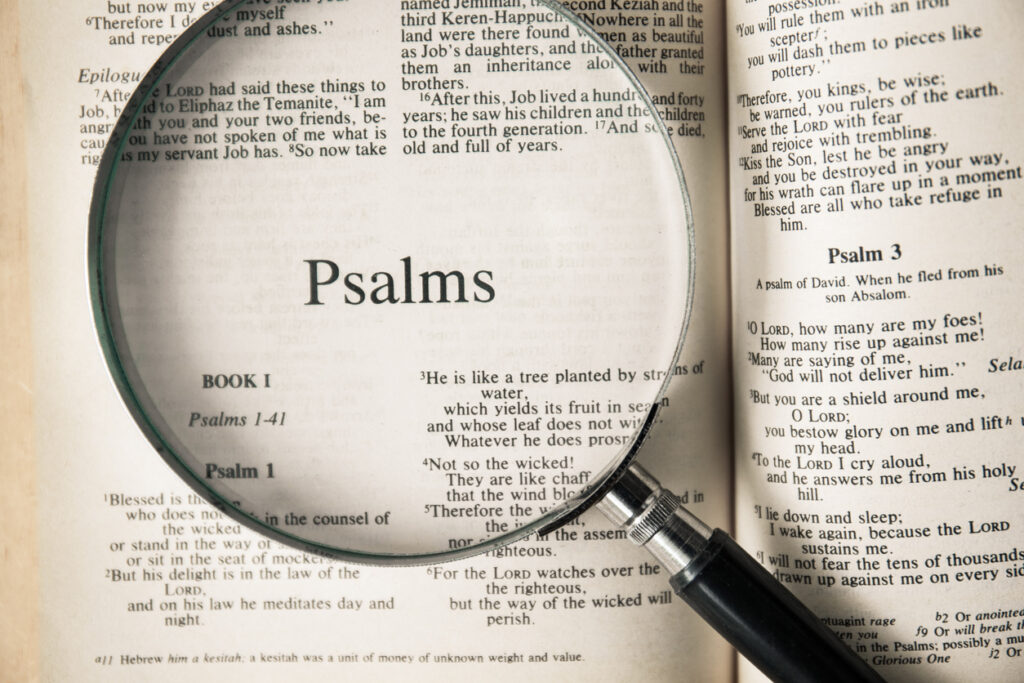

Welcome to Torah Today Ministries and our continuing series Tehillim Talks, our studies in the Psalms. And in this episode we will be looking into Psalm 71.
Now Psalm 71 is considered to be a continuation of Psalm 70. In fact, in one of the Jewish commentaries I have on the Psalms, the commentators combined Psalm 70 and 71 together as one psalm. Now, Psalm 70 was written by David as it says in the superscription, but Psalm 71 has no superscription because it’s obviously a continuation of 70. So, why was it divided? I’m not quite sure, but Psalm 71 has enough material and enough to say that it does stand alone as an outstanding psalm. I guess if something stands alone, that makes it outstanding, doesn’t it?
But anyways, one of the things that’s interesting about this psalm is that it was obviously written in David’s latter years. David only lived to be 70. And this was written in one of those latter years. And as you realize that, and it’s obvious from reading the psalm, you come to this insight that things really hadn’t changed.
When he was a young man, his enemies were pursuing him and persecuting him, trying to make life miserable for him. In his middle ages, his enemies were pursuing him, trying to destroy him, looking for any chink in his armor, any opportunity to bring him down. And now in his old age, it’s still the same old same old. His enemies are looking for any opportunity of weakness or a failure where they can just pounce on him and destroy him.
Now from this I think we can learn something very interesting about our walk of faith in this life and that is this. We are born into a war zone. And though we can experience peace internally because of our walk with God and our faith in him and the fact that we’re spiritually standing on the rock, out here there’s very little peace. And if you get to go through a period of peace and calm, then praise God for that. But I guarantee you it’s not going to last. Not until Messiah returns and establishes his kingdom here on earth.
So you know we have an eternity of peace ahead of us but here we are born into a war zone. So just thank God for the periods of R&R that you get to experience while you’re here. So throughout David’s life, conflict from the time he was a young boy fighting giants until he was an old man and even on his deathbed. We read in Samuel about the conflict over who his heir would be. So that’s another story.
So let’s just get right into the psalm. And one of the things I’ve done is when you see areas in a dark green, and I hope it shows up on your screen. I don’t want it to contrast too much with the black print, but if you look closely, you’ll see areas in dark green. And those areas are the places where I’m trying to emphasize time. Because in this psalm, David speaks of his birth, his youth, his old age, and even resurrection from the dead later. And you’ll find the word “continually” in this psalm three times because he’s showing how God is faithful over time in his life.
So, let’s just jump in. I’m not going to go into as much detail on each verse as I normally do except for one. Verse 15, but we’ll get to that later.
“In you, Adonai, do I take refuge. Let me never be put to shame. In your righteousness, deliver me and rescue me. Incline your ear to me and save me. Be to me a rock of refuge to which I may continually come.” (Psalm 71:1-3a)
And David did continually come to that rock of refuge throughout his life.
“You commanded that I should be saved, for you are my rock and my fortress. My God, rescue me from the hand of the wicked, from the grasp of the deviant and violent man. For you are my hope, O Lord, Adonai, my trust from my youth. Upon you I have leaned from the womb. From the belly of my mother you took me. My praise is continually of you. An example I have been to many and you are my strong refuge. My mouth is filled with your praise and all day long with your beauty.” (Psalm 71:3b-8)
Then verses 9 to 11, he skips now to his latter years:
“Do not cast me away in the time of old age. When my strength fails, do not forsake me. For my enemies speak concerning me, those who watch for my life consult together, saying, ‘God has forsaken him. Pursue and seize him, for there is none to deliver him.’” (Psalm 71:9-11)
You know, one of the things we learn from this verse we just read is how dumb our enemy is. They just don’t learn. When David was young, they thought, “Ah, we can get him. He’s easy prey.” And they were wrong. And then over the years of him running from Saul, they thought, “We can get him.” They were wrong. They didn’t get him. After he became king, they thought, “Now we can get him. He’s weak. We can destroy him.” And they couldn’t. And now he’s an old man. They still haven’t learned their lesson. They are eternally stupid.
And they look at him, they say, “God has forsaken him.” Now, why would they think God has forsaken him? Because he’s old. You know, if anything, the older we get, the more spiritually powerful and energized we should become.
You know, I’m in my 70s now. I’ve outlived King David. And but as I grow older, I know that my body is weakening. I don’t have the stamina and endurance that I used to have as a young man. And for many years on up into my 50s, I would have projects. I would build this and do that and go here and accomplish these things. But not so much anymore. It’s not a matter of what do I plan to do, but it’s more about what do I want to be?
And so my spiritual enemies may say, “Oh, look, he’s getting old. He’s getting tired. He’s not as strong as he was.” And physically, it’s correct. But hopefully spiritually my faith is stronger. My confidence in God is stronger. Hopefully I’m a little wiser than I was a few decades ago. And so we should become a growing threat to the enemy the older we get.
You know, reading this Psalm is a great encouragement to us old folks. And if you’re an elderly person listening to this, I hope Psalm 71 becomes something that you return to over and over again because I find it a great source of encouragement and strength as I realize I am way past the halfway point of my life. I’m living on the last third or last fourth of my years on this earth. And so I get great hope from reading this and great comfort from it.
But let’s continue on verses 12-16:
“O God, be not far from me. O my God, hurry to help me. May my accusers be put to shame and consumed with scorn and disgrace. May they be covered who seek my evil. But I will continually hope and I will praise you yet more and more. My mouth will tell of your righteous acts, of your deeds of salvation all the day. For I do not know the full numbers. With the mighty deeds of the Lord Adonai I will come. I will remind them of your righteousness, yours alone.”(Psalm 71:12-16)
“O God, from my youth you have taught me and I still proclaim your wondrous deeds. So even to old age and gray hairs, O God, do not forsake me until I proclaim your arm to another generation. Your power to all those to come.”(Psalm 71:17-18)
I love that David is realizing that when my life here ends, that does not mean the end of my influence. And if I am doing life right, then I can impact the generation to come and the generation after that and the generation after that. And when you realize that David composed this psalm around 3,000 years ago and it’s still impacting our lives today, I know it’s impacting mine. What an influence he has left. What a heritage he has left behind him.
And so I think we can take comfort in knowing that the things we do for God’s kingdom and that our lives as we pour them into God’s people and to build in his kingdom, these become eternal things. Things that will have repercussions will echo through the ages.
I think the most important and most driving force, the greatest desire in any human life is to know that your life matters. And when you think that the things I do to build God’s kingdom and as I pour my life into the lives of others, my life matters and it makes a difference for eternity. That’s something to hold on to.
Then verses 19 to 24:
“Your righteousness, O God, reaches the high heavens. You who have done great things, O God, who is like you? You who have made me see many troubles and calamities will revive me again. From the depths of the earth, you will bring me up again.” (Psalm 71:19-20)
In other words, the end of this life is not the end. David believed in the resurrection.
“You will increase my greatness and comfort me again. I will also praise you with a harp for your faithfulness, O my God. I will sing praises to you with a lyre, O Holy One of Israel. My lips will shout for joy when I sing praises to you. My soul also which you have redeemed. And my tongue will talk of your righteous help all the day long. For they have been put to shame and disappointed who sought to do me hurt.” (Psalm 71:21-24)
That’s a great psalm. And do you see the scope of this psalm from before David’s birth to his growing up to his old age to the resurrection to the future generations and even talking about continuing to sing God’s praises on into eternity. It’s a wonderful perspective stretcher. It helps us to stretch our peripheral vision spiritually so we see a bigger picture and that’s the way we need to walk in this life to have a big picture.
One of the things the enemy wants to do is to shrink our vision down to tunnel vision to where we only see one thing and it’s usually going to be a dark thing, a problem. But God says, “No, stretch your vision. Bring your perceptions out as far as you can. Look at the big picture and then there’s incredible hope and joy and gratitude and a great expectation of things to come.”
Now, you may have noticed back in verse 15, I had highlighted a couple words in red. And here’s verse 15 again:
“My mouth will tell…” (Psalm 71:15a)
And the root word there is samech-pey-resh (ס-פ-ר). Now as we look in this verb and you can see the three-letter root right here, these three letters are permutated and stretched into a whole family of words of nouns and of verbs. And they have incredible meaning and impact in the scriptures. And since this basic root is found twice in this verse, I thought this is a good time to discuss it.
So “your mouth will tell.” And some books, some dictionaries, thesauruses will say the root is safar (סָפַר) and some will say the root is sefer (סֵפֶר) or sippur (סִפּוּר).
And it says:
“My mouth will tell of your righteous acts of your deeds of salvation all the day. For I do not know the full numbers.”(Psalm 71:15)
And the word for “numbers” is sefarot (סְפָרוֹת). Seforah (סְפֹרָה) is the singular. And you can see there again it’s made of that three-letter root samech-pey-resh (ס-פ-ר).
Now this three-letter root is a source of fascination among the rabbis and has been for thousands of years. And they have written about this extensively even from some of their most earliest writings.
And so they say this three-letter root can be looked at in three different ways:
You can look at the word sefer (סֵפֶר). And that’s where we get the word book or scroll. In the Torah. The Torah is called the Sefer Torah (סֵפֶר תּוֹרָה), Torah scroll. It’s a Sefer Torah. And a scribe is called a sofer (סוֹפֵר) because he writes the sefer. And so it’s all about writing the text, writing the book.
But the word seforah (סְפֹרָה) means number. It’s where we get our English word cipher. It’s a word for numbers. And why the verse says, “I do not know the full numbers.” It kind of leaves translators scratching their head. Numbers of what? Numbers of years, numbers of people, numbers of the enemy. The numbers, it’s not explained, so I’m not going to try to explain it either. I have ideas, but they’re probably not even worth mentioning.
But you can also pronounce this root safar (סָפַר). And when you pronounce it safar, it means to tell. Or sippur (סִפּוּר) can be the telling.
So the rabbis look at these three applications of this three-letter root and they can refer to:
The Text – which would be the shape of the letters themselves, the ink on the parchment. So here’s a letter beit (ב). That’s the first letter of the Torah. The first word of the Torah begins with beit. Beresheet (בְּרֵאשִׁית) – in the beginning. So we can look at the shape of that letter, the ink as it adheres to the parchment. We can see it and there is part of the word of God. And as we look at the rest of the letters of the Torah, we see the text of the Torah.
The Numbers – But the letters also have a seforah. They have numerical values. And I know some people kind of turn up their noses at this. They pooh-pooh this and that’s, that’s a bunch of nonsense. Well, there are two extremes when it comes to the numerical values of the letters or the gematria.
Now, let me first of all say I’m not talking about numerology. I care nothing for numerology. That’s some kind of a cult practice where they’re trying to predict the future or something. I don’t understand it. Don’t want to understand it. That’s not what I’m talking about.
But every Hebrew letter has a numerical value. And you can see the patterns and words of the same numerical value and how they relate to one another. And this has been well known for many centuries.
And think about it. Should we be surprised that the God of the universe who created the periodic table of elements and the mathematical perfection and balance of the universe, that that same God who gave us the Torah, shouldn’t we see the same mathematical perfection and balance and harmony in his word? Of course we should.
And so don’t be surprised when you find these numerical balances and you find certain numbers repeated through scripture. Sevens are very important in scripture. Twelves are very important also, tens, 40s. We find the number 40 repeated over and over again. And in Revelation it tells us the number of the beast is the number of a man 666. So this is threaded through the scriptures from Genesis to Revelation.
Now there are two extremes we need to avoid. One extreme is to go way overboard to where we kind of leave studying and following the word of God, feeding on the word of God. We leave that in the rearview mirror because we’re so caught up in gematria and looking for codes and things like that. That’s an extreme. Avoid that extreme. Don’t be tempted by it.
But the other extreme is say “ah there’s nothing to it.” Those are two extremes that neither of which is healthy. But to realize there is a numerical pattern. There is numerical balance and harmony and beauty throughout the word of God. And to recognize it, to see it, and to praise God for his great wisdom and skill and the way he’s put every jot, every tittle.
So we see the shape of the letter, that’s the text, and we see the words made of the letters. We also can see the numerical values of the letters.
The Telling – But then we can also pronounce the letters. Each letter is a word. The letters string together to make more words. The words string together to make sentences and paragraphs and books. So that would be the communication, the telling, the story itself.
So we have the shape of the letters, that’s the sefer (סֵפֶר), the book, there’s the text; numerical values, that’s the seforah (סְפֹרָה); the telling, what is the message that these letters and these words tell us?
This letter here, as most of you probably recognize, is the letter beit (ב). It has a name, beit. Beit (בַּיִת) is the Hebrew word for house. And as you look at the letter, you can see that this letter, this house has a floor. It has a ceiling. It has a wall here and it has an opening. And since Hebrew reads from right to left, this first letter of the Torah is like a house from which all the words of the scriptures proceed.
So we can see the shape, numerical value is two. And I’ve spoken before, I hope you’ll watch the series I did called “Two Things Have I Heard” and it’s based on the verse in Psalms that says “one thing God has spoken but two things have I heard” and in that series I talk about how everything in the scripture is found in twos, found in pairs. And the very fact that the Bible begins with the letter beit is important for this. It starts with a number two. In fact, the letter beit looks like the Arabic two that we use.
Now, there’s one overarching word that is made of this same three-letter root samech-pey-resh (ס-פ-ר). And that’s the word sapphire – sappir (סַפִּיר). And I find this fascinating. And I know this goes beyond Psalm 71, but this is just too good to pass up. I should probably do a separate teaching in the Hebrew Key series about just this word sapphire and how it relates to this three-letter root.
But in Exodus 24, a stunning chapter, this is where the people of Israel are at Mount Sinai. Moses has gone up and God has spoken from Mount Sinai first of all and given the ten commandments and he’s given a number of commandments to Moses and Moses has written them down. He comes down from the mountain and he reads the book to them and they say everything God has said we will hear and we will do. And so he sprinkles the blood of the covenant on them.
And then Moses and Aaron, Aaron’s two sons, Nadab and Abihu, and 70 of the elders of Israel, including Joshua, are invited up to Mount Sinai to the top where they enjoy a covenant meal with God because you seal a covenant with a meal.
And it says in verse 10:
“And they saw the God of Israel. There was under his feet as it were a pavement of sapphire, which is sappir (סַפִּיר) in Hebrew – samech (ס), pey (פ), yud (י), resh (ר). But there’s that three-letter root samech-pey-resh (ס-פ-ר). A pavement of sappir like the very heaven for clearness.” (Exodus 24:10)
I’ll pause here for a moment. This is the first place the word sapphire appears in the scriptures. And when they see the God of heaven, the God of Israel, he is standing on a pavement of sapphire stone.
Now keeping in mind that this root that spells sapphire refers to the shape of the letters, numerical values of letters and the meanings of the letters and the words, the text, the numbers, the communication, the telling.
There’s an amazing picture being painted for us here. It’s saying if you want to see the God of Israel, if you want to experience him and draw close to him and have fellowship with him, to eat with him, we don’t live on bread alone, but by everything that proceeds from the mouth of God. The place you must go is to his word.
You have to go to his word. And that’s where we meet him because he was standing on stones of sappir, sapphire. Remember the word for sapphire is very similar to the word for sefer (סֵפֶר), for book. You have to go to the book.
Now I know that these days, these modern times and it’s better than nothing. I see a lot of people gazing at their phones. They don’t carry their Bibles with them anymore. They have these little boxes and they scroll through and find the verse. And again, this is better than nothing, but we are to be people of the book, not people of the tiny glowing screens.
And I found that when you can look at ink on paper, there’s something very visceral, very ancient about that practice of reading ink off of paper, which you can underline, you can mark, you can circle, and you have it all there at your fingertips at one time. You don’t have to look away from one place to go to another.
And I really encourage you. Be people with a book. Let your Bible be a book of paper and ink. Something where you can turn the pages and it’s tactile. And somehow it will stick with you. It will cling to your heart, your soul, your mind more than if it was just some temporary glowing symbols on a screen that you click a button and it all turns off and goes away.
Now, I happen to have here a sapphire, a piece of sapphire. Maybe in this camera you can see it best. You can see it’s a very deep blue, almost a purple color. Now not all sapphire is a deep blue purple like this but generally most of the time it is.
And in our verse it says that under his feet was pavement of sapphire stone like the very heaven for clearness. What color is the heavens? Blue.
And then over in Numbers, Numbers 15, God commands the people of Israel to put on the corners of their garments, tassels. Tassels. And to put on the tassels a cord of techelet (תְּכֵלֶת), which is the word for blue that we find in the Hebrew scriptures. And there is an actual techelet cord. And here you can see a tzitzit (צִיצִית), a tassel with a blue cord woven around and inside the tassel.
Why blue? Well, this is what the passage says in Numbers 15:38-39:
“Speak to the people of Israel and tell them to make tassels, tzitzit (צִיצִית) are what they’re called, on the corners of their garments throughout their generations to put a cord of blue, or techelet (תְּכֵלֶת), on the tassel of each corner. And it shall be a tassel for you to look at and remember all the commandments of Adonai to do them, not to follow after your own heart and your own eyes, after which you are inclined to prostitute yourselves.” (Numbers 15:38-39)
So the cord of techelet is something they can look down at that will remind them of the heavens. Just as the paving stones were like the heavens in clarity and in this blue.
I mentioned earlier that the Bible is made up of twos, of pairs, of everything. And it’s interesting that when you read the description of the choshen (חֹשֶׁן), the breastplate that the high priest wears, well here let’s look at the passage, it’s in Exodus 28:18. There are 12 stones, four rows of three stones each. And it’s interesting that it says in Exodus 28:18:
“In the second row, there’s an emerald, a sapphire, and a diamond.” (Exodus 28:18)
So row two, stone two is a sapphire because everything about the word of God comes in twos. And the first letter of the Bible is a beit which has numerical value of two. And again, I encourage you to listen to the series I did called “Two Things Have I Heard.”
But in Exodus 24:10, we saw paving stones of sapphire under God’s feet. But Ezekiel 10:1 says this:
“Then I looked, and behold, on the expanse that was over the heads of the cherubim, there appeared above them something like a sappir (סַפִּיר), sapphire, an appearance like a throne.” (Ezekiel 10:1)
And again, where does God seat himself on a throne? Sapphire. He walks on paving stones of sapphire. And it is referring to the sefer (סֵפֶר), the book, the seforah (סְפֹרָה), the numerical values and the sippur (סִפּוּר), the text, the meaning of what God is writing. It’s all about the book.
Unfortunately, we live in a time where it seems like reading is on the wane. Kids just want to watch TV or play on their tablets and play computer games and do as little reading as possible.
May I suggest that reading is a very spiritual activity. The enemy knows that. And since the beginning of writing, the enemy has used writing as a force for evil. But God has ordained writing and reading to be a source for good as well. That’s why he gives us his word in a book.
So if you find yourself not being a reader, you’re a human being. You have the ability to change yourself. Become a reader. Make yourself read. Maybe you don’t like food, but if you don’t eat, you die. Maybe you don’t like reading, but if you don’t read the word of God, if you don’t feed on everything that comes from the mouth of God, you die spiritually.
So, I encourage you, be a reader of the book, a studier of the book. Look deeply into it. And if you need some encouragement, read Psalm 119, which is a psalm, the longest psalm, the longest chapter in the Bible. The entire psalm is about the book.
So, God puts a great emphasis on this. And anyways, I could go on and on. I know you’re afraid I will. But, I thank you for listening, and I hope that I’ve encouraged you. If you’re in old age, don’t dread it. Enjoy it, and make your life count. If you’re young and you’re not thinking about old age yet, well, hold on to Psalm 71 for when you do get up here where I’m at and you start realizing death is the next great adventure and Psalm 71 will diffuse the fear and will give you strength to live your life well to the very last day. So until next time, I wish you shalom and may God bless.
[No Superscription]
1-8 In You, Adonai, do I take refuge; let me never be put to shame! 2 In Your righteousness deliver me and rescue me. Incline Your ear to me, and save me! 3 Be to me a rock of refuge, to which I may continually come. You commanded that I should be saved, for You are my rock and my fortress. 4 My God, rescue me from the hand of the wicked, from the grasp of the deviant and violent man. 5 For You are my hope, O Lord Adonai, my trust from my youth. 6 Upon You I have leaned from the womb. From the belly of my mother You took me. My praise is continually of You. 7 An example I have been to many, and You are my strong refuge. 8 My mouth is filled with Your praise, and all day long with Your beauty.
9-11 Do not cast me away in the time of old age; when my strength fails do not forsake me. 10 For my enemies speak concerning me; those who watch for my life consult together 11 saying, “God has forsaken him. Pursue and seize him, for there is none to deliver him.”
12-16 O God, be not far from me; O my God, hurry to help me! 13 May my accusers be put to shame and consumed; with scorn and disgrace may they be covered who seek my evil. 14 But I will continually hope and will praise You yet more and more. 15 My mouth will tell of Your righteous acts, of Your deeds of salvation all the day, for I do not know the full numbers. 16 With the mighty deeds of the Lord Adonai I will come. I will remind them of Your righteousness, Yours alone.
17-18 O God, from my youth You have taught me, and I still proclaim Your wondrous deeds. 18 So even to old age and gray hairs, O God, do not forsake me, until I proclaim Your arm to another generation, Your power to all those to come.
19-24 Your righteousness, O God, reaches the high heavens. You who have done great things, O God, who is like You? 20You who have made me see many troubles and calamities will revive me again; from the depths of the earth You will bring me up again. 21 You will increase my greatness and comfort me again. 22 I will also praise You with the harp for Your faithfulness, O my God; I will sing praises to You with the lyre, O Holy One of Israel. 23 My lips will shout for joy, when I sing praises to You; my soul also, which You have redeemed. 24 And my tongue will talk of Your righteous help all the day long, for they have been put to shame and disappointed who sought to do me hurt.
15 – My mouth will tell (ספר, saphar/sepher) of Your righteous acts, of Your deeds of salvation all the day, for I do not know the full numbers (ספרה, sephorah).
ספר (s-p-r)
sepher (ספר) = “book” TEXT
sephorah (ספרה) = “number” (“cipher”) NUMBER
saphar (ספר) = “to tell” / “telling” COMMUNICATION
Shape of the letters
Numerical values of the letters
Name + Sound of the letters
Exodus 24:10 And they saw the God of Israel. There was under His feet as it were a pavement of sapphire [ספיר, sappir ] stone, like the very heaven for clearness.
Exodus 28:18 …and the second row an emerald, a sapphire [ספיר, sappir ], and a diamond; [+39:11]
Ezekiel 10:1 Then I looked, and behold, on the expanse that was over the heads of the cherubim there appeared above them something like a sapphire [ספיר, sappir ], in appearance like a throne.
REFERENCES:
Verse 3
Psalm 91:11 For He will command His angels concerning you to guard you in all your ways.
Verse 15
Isaiah 54:11-13 “O afflicted one, storm-tossed, and not comforted, behold, I will set your stones in antimony, and your foundations I will lay in sapphires [ספיר, sappir]. Moreover, I will make your battlements of rubies, and your gates of crystal, and your entire wall of precious stones. And all your sons will be taught of Adonai; and the well-being of your sons will be great.”
Verse 18
Exodus 15:16 Terror and dread fall upon them; because of the greatness of Your arm (זרוע, zaroa), they are still as a stone, till your people, O Adonai, pass by, till the people pass by whom You have purchased.
Verse 20
Psalm 40:2 He drew me up from the pit of destruction, out of the miry bog, and set my feet upon a rock, making my steps secure.
Numbers 15:38-39 “Speak to the people of Israel and tell them to make tassels on the corners of their garments throughout their generations, and to put a cord of blue [תכלת, techeilet] on the tassel of each corner. And it shall be a tassel for you to look at and remember all the commandments of Adonai, to do them, not to follow after your own heart and your own eyes, after which you are inclined to prostitute yourselves.”