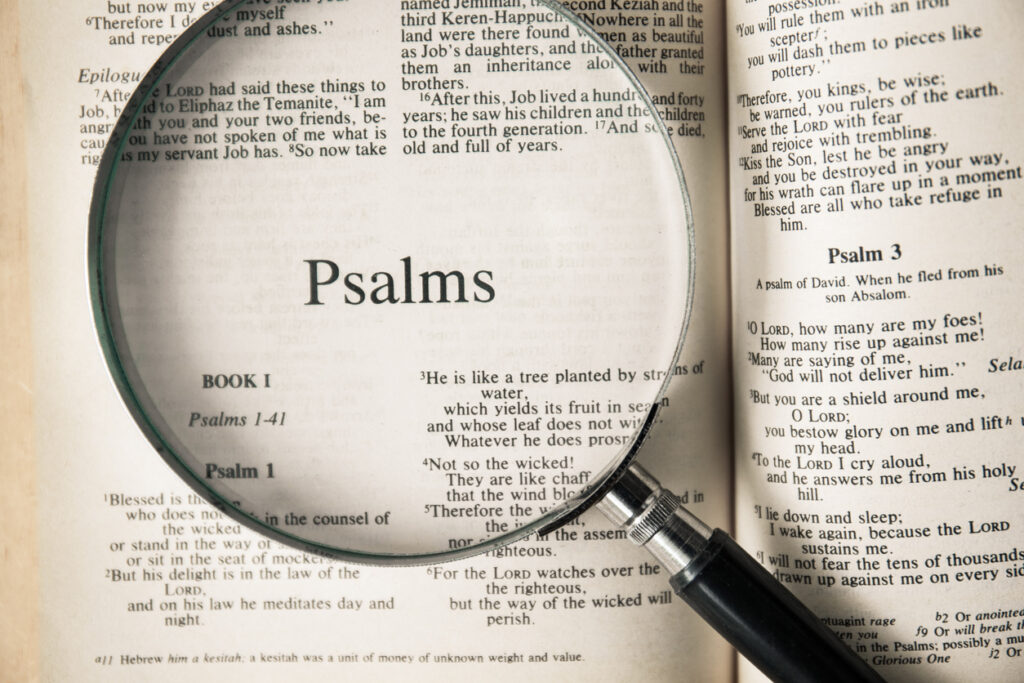
Welcome to Torah Today Ministries and our continuing series Tehillim Talks, our studies in the Psalms. And in this episode, we’ll be looking into this magnificent messianic psalm, Psalm 72.
And you may recall from the very first video of the Tehillim Talks series I introduced the fact that the book of Psalms has traditionally been divided into five books. They call them the Genesis book, the Exodus book, Leviticus book and so on. In fact, your Bible may have these delineations marked in it. And this psalm brings book two, the Exodus book to a conclusion.
Now this psalm has an interesting superscript. It says “of Solomon” or “for Solomon” and there is some debate as to which way this should be translated. Is this a psalm that was written by Solomon or is it a psalm written by David to Solomon?
Now the Jewish view on this has traditionally been this is a psalm written by David for his son Solomon. And if you look at the very last verse of the psalm verse 20 it has this interesting postscript which says “the prayers of David the son of Jesse are ended.” In other words with this psalm the prayers of David that are recorded in the book of Psalms come to a conclusion. Well, if David didn’t write this psalm, why would it put this postscript at the end of this psalm?
Now, before we get any further confusion, because you’re going to say, well, wait a minute. If as I page through the Psalms, I find more Psalms written by David. And yes, you do. But it says here that here ends the prayers of David. And the psalms you see written by David later in the book of Psalms are hymns of praise to God, not prayers, not requests. So this brings the prayers of David to a conclusion. So if this is to be applied to Psalm 72, then this is indeed a prayer of David for his son Solomon, his successor to the throne of Israel.
Now the reason there is some confusion about this is because in Hebrew “of Solomon” or “for Solomon” is liShlomo (לִשְׁלֹמֹה). Shlomo (שְׁלֹמֹה) is Solomon’s name in Hebrew. When you put the letter lamed (ל) in the front it can mean “to” or “for” or “ascribed to.” The psalms that are written by David say l’David (לְדָוִד). Has David’s name with a lamed in the front. And we know they’re written by David. So we can look at this again. It’s written by Solomon, but I choose to believe it’s written to Solomon. And I think there’s plenty of proof in here that this is a prayer of David for his son’s success in reigning on the throne.
So, let’s get right into the psalm. It is an amazing amazing psalm. And what we have to remember is that this entire psalm which is a psalm for the success of the son of David who is Solomon, we must see in it a foreshadowing of the greater son of David who is Messiah.
And there is some proof that is encoded into this psalm to tell us who this psalm is really about. So, as you read through here, I want you to read it as a psalm that is describing our Messiah Yeshua (יֵשׁוּעַ) and his reign because what is described here goes far beyond any mere human kingly reign. This is something that is eternal, that is universal, that covers the whole world for all time. And so just keep tuned in to those hints and those applications of the words and the verses that we’ll be reading.
So here’s how it begins:
“Give the king your justice, oh God, and your righteousness to the royal son.” (Psalm 72:1)
So we see here that this psalm is for the king and it’s for the royal son. And who is the son? Who is the king? Well, the son of David was King Solomon. But the great son of David, of course, is Yeshua HaMashiach (יֵשׁוּעַ הַמָּשִׁיחַ). Yeshua, King Messiah.
“May he judge your people with righteousness and your poor with justice. Let the mountains bear prosperity for the people and the hills in righteousness. May he defend the cause of the poor of the people, give deliverance to the children of the needy and crush the oppressor.” (Psalm 72:2-4)
“May they fear you with the sun and before the moon throughout all generations.” (Psalm 72:5)
Now, I guarantee you your translation of verse 5 is not the same as this. Translators are all over the map trying to translate verse five and these references to the sun and the moon. So I’ve put them here just very literally the way it would appear in the Hebrew or way it does appear in the Hebrew. And we’ll be coming back to verse 5 a little bit later on to look more deeply into this. But twice the sun is referred to in this psalm and twice the moon. And we’ll be considering some reasons why the sun and the moon play such a big part in this psalm. So just hold on. We’ll get to that momentarily.
“May he be like rain that falls on the mown grass, like showers that water the earth. In his days, may the righteous flourish and peace abound till the moon be needed no more.” (Psalm 72:6-7)
Now, one of the things I want you to notice about this, and you’ll see it continue on through the psalm, is it would seem that the curse we find back in Genesis chapter 3 after Adam and Eve introduced sin into the world, the curse that was on the earth to bring forth thorns and thistles. It’s like here through this royal reign of the son of the king, the curse is being reversed.
For example, it talks about “let the mountains bear prosperity for the people.” For prosperity, it’s talking about a rich harvest. Well, mountains don’t generally produce great harvest. You find the crops and the produce down in the valleys. And of course, in Israel, you do find some terracing going on on the hills. But the language here is as if the mountains right to the very peak are just covered with wheat or corn or whatever is being produced. These rich crops are covering the mountains. And then it talks about the rain that falls on mown grass. Why is the grass mown? The grass has been cut. It’s been destroyed. It’s been cut down somehow. But it’s like the showers will rain on this and restore what was cut away. We see words of restoration and of amazing agricultural abundance in these verses.
Now, one of the interesting things here, it says, “May he be like rain that falls.” How can the king be described as rain that falls? Well, what’s interesting is the Hebrew word for princes, not princess, princes—sons of the king, sons of the chieftain—is also a word that can be translated clouds. Let me give you some examples of this.
In Genesis 17:20, it says, Ishmael shall father 12 princes. And that word for princes is the word nesiim (נְשִׂיאִים). It says, “He will father 12 princes, and I will make him into a great nation.”
But that exact same word nesiim is used also in Psalm 135:7:
“He it is who makes the nesiim, makes the clouds rise at the end of the earth, who makes lightnings for the rain, and brings forth a wind from his storehouses.” (Psalm 135:7)
In Proverbs 25:14:
“Like nesiim, like clouds and wind without rain is a man who boasts of a gift he does not give.” (Proverbs 25:14)
So this word nesiim (נְשִׂיאִים) can mean princes, sons of the king, or clouds that give rain.
And it could be that this play on words is in the mind of David as he writes this psalm. And when you think about what a godly king does, he should be like the clouds. Now, here in northeast Ohio, where it’s cloudy almost all the year round, clouds are not looked on very favorably. We love it when there are no clouds and the sun comes shining through. But in the Middle East, in the area of Israel and so on, clouds are an incredible blessing. They provide two important things. First of all, shade. They bring some shade and protection from the sun and brings comfort and some coolness. But also they bring rain. Rain is so important. Rain is considered a blessing. Whenever they get rain, they’re praising God for the rain because with no rain there are no crops.
So it says the king should be like the clouds. He should be like the rain that falls on the destroyed, the mown grass. So a king protects, he brings shade to his people and provides sources of sustenance to them. And of course this will be the case with Messiah.
But what will you make of all these references to the sun and moon? Well, you know, back in Genesis chapter 1, God made two great lights. One to rule the day, one to rule the night—the sun and the moon. And we know scientifically that the moon is not a light source. It reflects to the earth the light that comes from the sun. So the sun is the source. But at night, the sun can’t be seen. But if the moon is doing its job, it will reflect the light of the sun to the earth. So the sun and the moon, the lights that rule the day and the night are really important symbols in scripture.
Let me just read two passages to you. The first one is in Jeremiah 31:35-36:
“Thus says Adonai, who gives the sun for light by day, and the fixed order of the moon and the stars for light by night, who stirs up the sea so that its waves roar, Adonai of hosts is his name. And this is what he says: If this fixed order departs from before me, declares Adonai, then shall the offspring of Israel cease from being a nation before me forever.” (Jeremiah 31:35-36)
I just wish so many politicians and modern theologians would read this verse and take it to heart. He’s saying if the sun and moon quit doing their jobs, then Israel will quit being my children. They’ll quit being my covenant people. So the sun and moon are testimonies of God’s faithfulness. Regardless of what’s happening on earth, the sun comes up every day right on schedule and the moon follows through its cycles exactly on time. It never misses a beat.
But also a couple chapters further on, Jeremiah 33:19-21:
“The word of Adonai came to Jeremiah. Thus says Adonai, if you can break my covenant with the day and my covenant with the night, so that day and night will not come at their appointed time, then also my covenant with David my servant may be broken, so that he shall not have a son to reign on his throne, and my covenant with the Levitical priest, my ministers.” (Jeremiah 33:19-21)
He says, “If you can break my covenant with the day and night, okay, then my covenant with David, that I will always have a son of David, the son of David ruling on the throne, then you can break that covenant as well.” So, we know for a fact the son of David will rule on the throne in Jerusalem because God has decreed it. So the sun and the moon don’t just give lights to the earth, but they are also testimonies of God’s covenant faithfulness to his people Israel and to the son of David, Solomon, but more particularly Messiah himself.
Now, we’re going to see some more about the sun and moon here. And again, we’re going to come back to verse 5 where it says, “May they fear you with the sun and before the moon throughout all generations.” We’re going to come back to that later. So, just keep that in mind for now. Now, we’ll move a little more quickly through the rest of this psalm.
“May he have dominion from sea to sea and from the river to the ends of the earth. May desert tribes bow down before him and his enemies lick the dust. May the kings of Tarshish and of the coastlands render him tribute. May the kings of Sheba and Seba bring gifts. May all kings fall down before him. All nations serve him.” (Psalm 72:8-11)
So we see this is a universal reign of King Messiah. Solomon’s reign never did reach the whole world. So this psalm has to be looking to something beyond King Solomon himself. It has to be looking towards Messiah, the son of David.
Now the question is why would the king of Israel be the king over all the earth? I mean the king of England is not the king of all the earth and the king of some other country isn’t king over all the earth. What makes this king of Israel not just king of Israel but king over all the earth?
That question can only be answered by looking at Yeshua, at Messiah. Because all over the world there are those who have become his subjects who have pledged their allegiance and their loyalties to him to King Messiah and have become members of his kingdom. And we are grafted into his people. We’re grafted into his kingdom. And we find that his house of prayer is to be a house of prayer to all nations.
And so wherever the king conquers, that becomes his property. And if he has conquered your heart, no matter where on the globe you live, you’re his property. And that which belongs to you belongs to him. And so I think what we see here is as King Messiah conquers the hearts of people all over the world, people all over the world become his. And so he’s not the king just of his covenant people Israel, but he’s king over all of those whom he has redeemed and who have given their loyalties, their love, and their service to him.
“For he delivers the needy when he calls, the poor and him who has no helper. He has pity on the weak and the needy and saves the lives of the needy. From oppression and violence he redeems their life and precious is their blood in his sight.” (Psalm 72:12-14)
“Long may he live. May gold of Sheba be given to him. May prayer be made for him continually and blessings invoked for him all the day. May there be abundance of grain in the land. On the tops of the mountains, may it wave. May its fruit be like Lebanon. And may people blossom in the cities like the grass of the field. May his name endure forever. His fame continue as long as the sun. May people be blessed in him. All nations call him blessed.” (Psalm 72:15-17)
So again, we see the curse reversed. We see the whole world coming under the authority and kingship of King Messiah. It’s an amazing psalm.
And then we come to the conclusion:
“Blessed be Adonai, the God of Israel, who alone does wondrous things. Blessed be his glorious name forever. May the whole earth be filled with his glory. Amen and amen.” (Psalm 72:18-19)
Now, what’s interesting is that the last psalm in the Genesis book ends with amen and amen. And here, the last psalm of the Exodus book ends with amen and amen. And we’ll find later the last psalm in the Leviticus book ends the same way. So, this is kind of a typical thing that happens in the last psalm of each of the books of Psalms.
Now, as promised, we’re going to go back to verse five because this answers the question, who is this king? Who is this king who’s going to rule over the whole earth? Whole earth is going to bring tribute to him, who’s going to usher in this kingdom. Where the curse that God placed on the earth back in Genesis 3 is reversed and where there’s utter abundance, where there’s utopia, just perfection on earth. Who is this king? What is his identity?
Well, believe it or not, it is encoded here in verse 5. Now, here’s the verse:
“May they fear you with the sun and before the moon.” (Psalm 72:5a)
Now, this translation is a literal translation of the Hebrew. And here you can see the Hebrew. It’s only four words: im shemesh (עִם־שֶׁמֶשׁ) v’lifnei (וְלִפְנֵי) yareach (יָרֵחַ). “With the sun and before the moon”—four words in Hebrew. Im (עִם) which means “with,” shemesh (שֶׁמֶשׁ), sun, v’lifnei (וְלִפְנֵי) “and before” or “in the face of”—paneh (פָּנֶה) is face—yareach (יָרֵחַ) that’s moon. With the sun and before the moon, four words.
Now the rabbis who look in such incredible detail into the letters and the wording of the scriptures have discovered something quite amazing. So this is not my discovery. This has been around for a long time. But I just want to share it with you.
If we take the last letter of each of those four words—mem (ם), shin (ש), yud (י), and chet (ח)—it spells the word Mashiach (מָשִׁיחַ), Messiah.
So, who is the king? Who is the king who they shall fear with the sun and before the moon throughout all generations? It is the Messiah.
But there’s more. What is this Messiah’s name?
Well, if we take the first letter of each of these four words—ayin (ע), shin (ש), vav (ו), and yud (י)—it spells the name Yeshua (יֵשׁוּעַ).
Yeshua is the Mashiach. He is the Messiah. Now, you may say, well, wait a minute. The first letters of those four words, they don’t spell his name in order. That’s because Yeshua comes incognito. He comes in a hidden way. But those are still the four letters that spell his name. Yeshua. Yeshua HaMashiach (יֵשׁוּעַ הַמָּשִׁיחַ).
Now the question that arises in my mind is if God is going to encode the identity of this king, this son of David, Yeshua, the Messiah. Why does he encode it into these four words? He could have made any four words to encode them into. But why four words that have to do with the sun and with the moon?
Well, if you followed my series “Two Things Have I Heard,” you know that everything comes in pairs. And when God brought light into the world, he did it through the sun and the moon. One for the day, one for the night. When he brings his scriptures into the world, he does it through the Hebrew scriptures and the Greek scriptures. When he brings his word made flesh into the world, he does it through his first coming and through his second coming in the future. Everything God does, he does in pairs.
So if Yeshua is indeed the light of the world, which he is, then that light comes in two ways. We have the sun and we have the moon. What is this all about? Well, remember which of these two is actually a light source and which is a light reflector, a vessel for the light. The sun is the source. The moon is a reflector. It’s a vessel for the light that provides light to us during the darkness.
When we look at the scriptures, if we look at the word of God, we’ll notice that the word “scriptures” and the word “word” are used in very distinct ways.
The scriptures are physical. I don’t have my Bible on the table right here, but I can pick up—here’s a copy of the book of Psalms. So, these are scriptures. It’s physical. It’s paper and ink. I can pick this up. I can carry it. I can respect it. I can disrespect it. I can put it in a place of safety. I can throw it in the fire and burn it. The scriptures are physical. They’re like the moon. We’ve sent men to the moon. It’s a physical place. And the scriptures are physical. They’re inspired. Don’t get me wrong. They are inspired.
But the scriptures are not called the word of God. The word of God is utterly spiritual. And the way we access the word of God is through the scriptures of God. Think of it this way. Think of the scriptures as being the window. And I go to the window to see the light which is the word of God.
These are what reflect the living word of God. In Hebrews 4, it says:
“For the word of God is living and active, and sharper than any two-edged sword.” (Hebrews 4:12)
The word of God is alive. It’s utterly spiritual. You cannot destroy the word of God because the word of God is absolutely spiritual in its essence. It’s eternal and it is perfect. And it’s the word that became flesh and dwelt among us. The word is the light source, but the word is communicated to us through the physical scriptures of ink on parchment, ink on paper in this case.
And so since God’s word comes to us in this way, remember God’s word is spiritual. It’s not physical. Yet we need the physical Bible so we can somehow come in contact and begin to know and see his word. The scriptures don’t give life. The word of God gives life. But without the scriptures, you can’t touch the word of God. You can’t access the word of God. But we have to make this distinction.
This is why when it comes to translations, we’re always trying to figure out exactly what the scriptures are saying so that our window that lets the light through is clean. It’s not soiled and muddled and dusty. We want the light of God’s word to come clearly through his scriptures. So, a good translation and a good understanding of the scriptures is necessary to fully access the light, the living light of God’s face to come through.
You know, I can teach a parrot to memorize Bible verses, but that parrot doesn’t know the word of God. And people too can be expert in the scriptures as were the leaders in Yeshua’s time. And yet they did not recognize the word and they crucified him.
So study the scriptures. Make sure you can use the scriptures skillfully and know them and understand them. But realize the scriptures are not the end in themselves. They’re simply the scabbard for the sword of the spirit.
And we must learn to draw the word of God out of the scabbard of the scriptures. It’s the word of God that is living and active and sharper than a two-edged sword. It’s the word of God that is the sword of the spirit. This is the scabbard in which we can find it. This is the scabbard in which we carry it and protect it. But we can beat each other and bruise each other up by trying to beat each other with their scabbards instead of using the sword against our enemy.
Is it making sense? I hope it is. I wish you were here so you could raise hands and ask questions. But when we see the sun and the moon, the moon is like a vessel for the eternal light of the sun. And so in this passage—im shemesh v’lifnei yareach (עִם־שֶׁמֶשׁ וְלִפְנֵי יָרֵחַ)—we find encoded Yeshua the Messiah. It’s an amazing thing.
I could sit and talk about this all day, but we have to move on.
And of course, we have our final concluding verse, verse 20, which says:
“The prayers of David, the son of Jesse, are ended.” (Psalm 72:20)
Now, again, we’re going to see more psalms by David in the rest of the book, but these are going to be hymns of praise and giving glory to God. But all the psalms about moaning and asking God to do things and bail me out of this trouble, those are pretty much all over. Those are found in the first two books, the Genesis and Exodus books. But now we’ll be reading a lot of Psalms by other authors and also some hymns of praise by David.
So I’m excited to get into book three of Psalms. And I hope you’ll join me here for Psalm 73. In the near future, we’ll get that studied and recorded for you. And I hope you’re enjoying this series as much as I am producing it.
So until next time, may God bless and I wish you shalom (שָׁלוֹם).
Of Solomon
– or –
For Solomon
1-7 Give the king your justice, O God, and Your righteousness to the royal son! 2 May he judge Your people with righteousness, and Your poor with justice! 3 Let the mountains bear prosperity for the people, and the hills, in righteousness! 4 May he defend the cause of the poor of the people, give deliverance to the children of the needy, and crush the oppressor! 5 May they fear You with the sun and before the moon throughout all generations! 6 May he be like rain that falls on the mown grass, like showers that water the earth! 7 In his days may the righteous flourish, and peace abound, till the moon be needed no more!
8-11 May he have dominion from sea to sea, and from the River to the ends of the earth! 9 May desert tribes bow down before him, and his enemies lick the dust! 10 May the kings of Tarshish and of the coastlands render him tribute; may the kings of Sheba and Seba bring gifts! 11 May all kings fall down before him, all nations serve him!
12-14 For he delivers the needy when he calls, the poor and him who has no helper. 13 He has pity on the weak and the needy, and saves the lives of the needy. 14 From oppression and violence he redeems their life, and precious is their blood in his sight.
15-17 Long may he live; may gold of Sheba be given to him! May prayer be made for him continually, and blessings invoked for him all the day! 16 May there be abundance of grain in the land; on the tops of the mountains may it wave; may its fruit be like Lebanon; and may people blossom in the cities like the grass of the field! 17 May his name endure forever, his fame continue as long as the sun! May people be blessed in him, all nations call him blessed!
18-19 Blessed be Adonai, the God of Israel, who alone does wondrous things. 19 Blessed be His glorious name forever; may the whole earth be filled with His glory! Amen and Amen!
Verse 5 May they fear You with the sun and before the moon, throughout all generations!
עם שמש ולפני ירח
משיח = Mashiach
עם שמש ולפני ירח
ישוע = Yeshua
[Postscript:]
20 The prayers of David, the son of Jesse, are ended.
REFERENCES:
Verse 3
Genesis 3:17-18 And to Adam He said, “Because you have listened to the voice of your wife and have eaten of the tree of which I commanded you, ‘You shall not eat of it,’ cursed is the ground because of you; in pain you shall eat of it all the days of your life. Thorns and thistles it shall bring forth for you, and you shall eat the plants of the field.”
Verse 5
Jeremiah 31:35-36 Thus says Adonai, who gives the sun for light by day and the fixed order of the moon and the stars for light by night, who stirs up the sea so that its waves roar – Adonai of Hosts is His name: “If this fixed order departs from before me, declares Adonai, then shall the offspring of Israel cease from being a nation before me forever.”
Jeremiah 33:19-21 The word of Adonai came to Jeremiah: “Thus says Adonai: “If you can break My covenant with the day and My covenant with the night, so that day and night will not come at their appointed time, then also My covenant with David my servant may be broken, so that he shall not have a son to reign on his throne, and My covenant with the Levitical priests My ministers.”
Verse 6
Genesis 17:20 “… [Ishmael] shall father twelve princes (נשיאים, nasi’im), and I will make him into a great nation.”
Psalm 135:7 He it is who makes the clouds (נשיאים, nasi’im) rise at the end of the earth, who makes lightnings for the rain and brings forth the wind from His storehouses.
Proverbs 25:14 Like clouds (נשיאים, nasi’im) and wind without rain is a man who boasts of a gift he does not give.
Verse 7
Isaiah 60:19-20 The sun shall be no more your light by day, nor for brightness shall the moon give you light, but Adonai will be your everlasting light, and your God will be your glory. Your sun shall no more go down, nor your moon withdraw itself, for Adonai will be your everlasting light, and your days of mourning shall be ended.
Revelation 21:23 And the city has no need of sun or moon to shine on it, for the glory of God gives it light, and its lamp is the Lamb.