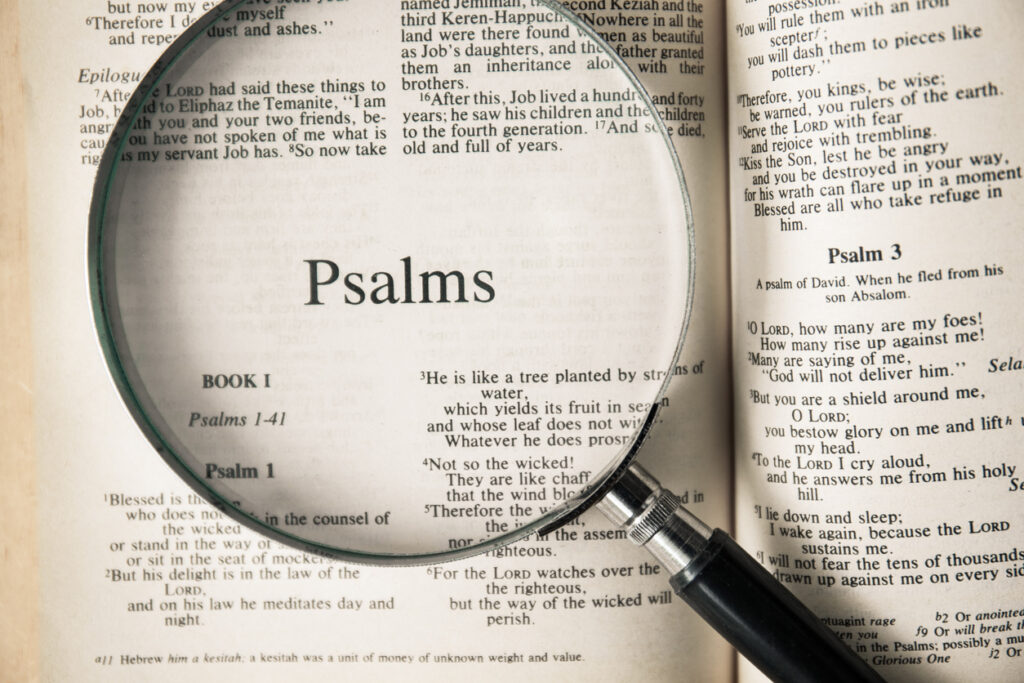
Welcome back, everyone, as we continue our discussions in the Psalms with Tehillim Talks, Psalm 2. This is an amazing psalm, and it packs so much into these 12 short verses. So let’s begin by doing this.
I’m going just to read straight through the psalm, and I want you to notice the four divisions. Verses one through three begin with a question, and then the kings of the earth speak. And this is what is said.
Question:
Why do the nations rage and the peoples meditate emptiness? The kings of the earth take their stand, and the rulers take counsel together against Adonai and against his Messiah, saying, “Let us burst their bonds apart and cast away their cords from us.” (Psalm 2:1–3)
And then the next three verses, God speaks:
“He who sits in the heavens laughs. The Lord holds them in derision. Then he will speak to them in his wrath and terrify them in his fury, saying, ‘As for me, I have set my King on Zion, my holy hill.’” (Psalm 2:4–6)
And then in the next three verses, the Messiah speaks:
“I will tell of the decree. Adonai said to me, ‘You are my son. Today I have begotten you. Ask of me and I will make the nations your heritage and the ends of the earth your possession. You shall break them with a rod of iron and dash them in pieces like a potter’s vessel.’” (Psalm 2:7–9)
And then in the last three verses, it seems like the psalmist himself, the one who’s writing the psalm, is speaking, or maybe it’s Messiah who’s continuing to speak:
“Now therefore, O kings, be wise, be warned, O rulers of the earth. Serve Adonai with fear and rejoice with trembling. Kiss the son, lest he be angry, and you perish in the way when his wrath is kindled but a little,” or “soon.” “Contented are all who take refuge in him.” (Psalm 2:10–12)
So we have 12 verses: the first three, the kings of the earth speak; the next three verses, God speaks; the next three verses, Messiah speaks; and the last three, it seems like the psalmist himself is then speaking to the reader.
So let’s go back through and take some time and look at a few details that I think will help open the psalm to you. Now before we do that, I just want to share something with you. My purpose in doing the Tehillim Talks is not that you understand each psalm thoroughly, completely, totally, and have no questions ever the rest of your life about that psalm. I don’t think anyone could accomplish that task. What I want to do is give you some tools to allow you to unlock the psalm, to look at it a little more deeply, so that in the future, for the rest of your life, whenever you read this psalm, it will speak to you a little bit more. So I’m here to help clear away some of the obstacles that might prevent you from looking a little bit more deeply into the psalm and to unlocking a few of its secrets.
So let’s begin. The question:
“Why do the nations rage and the peoples’ meditate emptiness?” (Psalm 2:1)
That word “meditate” is the exact same word that is used back in Psalm 1 that we looked at last time, the word haga—to meditate, just to be still, to be quiet, and to draw close and to look at something. Now we are to meditate upon God’s Torah. We’re to look at it and let it breathe into us. We draw close to God through it and he draws close to us. But that’s not what these nations are doing. They’re meditating reek. They’re meditating emptiness, nothingness.
And I mentioned last time, I believe, that the difference between biblical meditation, which is always on God’s word, and the kind of meditation practiced in Eastern mysticism, is that in Eastern mysticism, they meditate on nothing. They meditate on emptiness. You want to empty your mind of everything. And God never wants us to empty our minds. He wants us to meditate on something that is in our mind, which is His word.
So the question is: Why do the nations rage and the peoples meditate emptiness? Maybe one of the reasons they rage is because they’re meditating on emptiness. Maybe if they meditated on God’s word, they wouldn’t be so angry.
And then it says, “The kings of the earth take their stand.” Remember in Psalm 1, it opens with,
“Contented is the man who walks not in the counsel of the ungodly, nor stands in the way of sinners, nor sits in the seat of the scornful.” (Psalm 1:1)
But now here we see the kings of the earth taking their stand, and the rulers take counsel together—against who? Against Adonai and against his Mashiach.
The word Mashiach, which we translate “Messiah,” and which in Christianity and in the Greek scriptures translates Christos or “Christ,” literally means “anointed,” one who is anointed. David refers to himself as a Mashiach. And we see different Mashiachs, different anointed people throughout the scriptures. And what we must remember when we see the word Mashiach is to look at the context and try to understand whom it is speaking about.
Now, in scripture there were three offices where the office-holders had to be anointed. The prophet was anointed, the priest was anointed, and the king was anointed. So we have three positions that require anointing for inauguration into that position. Now we know that Messiah Yeshua is both a prophet and a priest as well as our King. And when the scriptures refer to the Messiah, ha-Mashiach, it’s referring to one person, and that would be Yeshua.
Now, one of the things we need to realize is that in Hebraic thought, when the scriptures refer to the Messiah, they realize it’s referring to a prophet and to a priest, but primarily in their thought is that he is the King. He is the King. And so when you read in your English translations and you see “Christ Jesus,” or as we would say, “Messiah Yeshua,” in your mind, just take that and interpolate it into “King Yeshua,” King Jesus. He is the King.
I am amazed at how many of my evangelical friends, they can tell you about Jesus, but when I ask them what the word “Christ” means, they’re a bit at a loss. They don’t really understand the office of the Messiah. But when I speak to my Jewish friends, they may not be able to tell you much about Yeshua, about Jesus, but they can tell you a great deal about the Messiah and who he is. And what we need to do is we take the Hebrew scriptures and the apostolic writings and put them together.
We know who Yeshua is, and we know what Messiah is, and we realize that Yeshua is that. He is the King. And that should be the overarching idea in our minds whenever we see the terms “Christ Jesus” or “Jesus Christ”—King Yeshua.
So, they take counsel together against Adonai and against his anointed one, against his Messiah, and they say,
“Let us burst their bonds apart and cast away their cords from us.” (Psalm 2:2–3)
Boy, doesn’t that sound like the world today? Anything that smacks of biblical morality, biblical virtue, biblical standards, the world wants to throw them away, as if that is the source of all of our problems. But just the opposite is true. By casting away the scriptures, by moving away from the Word of God, that has been a source of our problems. And the only thing that will solve the problems we have today is for people to move back to God, back to His Word, back to His standard of how to live this life.
But we see the nations raging. We hear the noise they make as they try to throw away any restraints that the Word of God might try to put upon them.
Now that word there for “bonds”—“let us burst their bonds apart”—is a very interesting word. The plural word that is used here is the word mos’roth, moseroth. And it comes from a root, musar.
Now, musar is a very important word in the scriptures. That is an important area of study. You find this word in the Book of Proverbs more than any other book of the Bible. In fact, it’s used 30 times in the Book of Proverbs. Sometimes the translators translate musar as “instruction.” Other times they translate musar as “discipline.” And in one place, the New American Standard, it’s translated as “punishment.”
But the best way to think of musar is instruction and discipline together—instruction that requires discipline. Let me give you an example. If you come visit me and I look into the backyard and I point out maybe some of the wildlife—“That’s a Canadian goose and that’s a gray squirrel.” If you didn’t know that before, you’ve just received some instruction. But there’s no discipline involved.
On the other hand, if I sit with you and start trying to teach you how to play the piano, now that’s going to require a lot of practice on your behalf to master that instrument. And so I can give instruction, but there must be practice, there must be self-discipline, self-control. There’s going to be some sacrifice involved. And that is the sense of the word musar.
In the Jewish world, people will study the scriptures each day, but they’ll also study a book of Musar. And many of the great rabbis over the centuries have written works of Musar—books that will help you develop your character traits. It will help you to practice self-discipline, to overcome faults and addictions and habits and replace those with better habits and a better way of living. And if you look closely as you read the apostolic scriptures, you’re going to see that musar—self-discipline, self-improvement, working on your soul, becoming more like a Messiah, being a disciple—requires a great deal of self-application, self-discipline. So musar is a theme that runs throughout the scriptures. And almost every time we’re given a commandment concerning ourselves, there’s an element of musar there.
So the nations rage and they say, “Let us throw off their mos’roth, all their bonds—anything that has to do with self-discipline and self-control—and cast away their cords.”
And the word for “cord” there is a word that is avot. It sounds just like the Hebrew word avot. Two words that sound exactly the same—they’re homophones. But the word used here, avot, means the ropes, the kind of ropes that would fasten a yoke to the neck of an ox. But the other word avot—pronounced exactly the same way, just spelled a little differently—is the word that means “fathers.” So if you hear someone speaking Hebrew and they say avot, they can be talking about ropes or they can be talking about the fathers. And the fathers being Abraham, Isaac, and Jacob. Whenever you read in the scriptures and it refers to avot, the fathers, it’s referring to Abraham, Isaac, and Jacob.
And I think this is a bit of a play on words, because the nations, as they want to throw off the ropes of the yoke that God would have us yoked to, they’re also throwing off the heritage of Abraham, Isaac, and Jacob—these patriarchs of the people of Israel.
So this is what the kings of the earth are saying. So in verse 4 now, God speaks. It says, “He who sits in the heavens laughs.” (Psalm 2:4)
I have to think back to Psalm 1, where it talks about the seat of the scorner. The scorner is one who seats himself and he looks down his nose at people and he criticizes them. He derides them for the way they live because he knows better than anyone else. The scorner is a master of criticism. He’s a master of finding fault. So here’s the scorner sitting in his lofty perch, looking down at everyone else as being inferior to himself. But verse 4 says, “He who sits in the heavens laughs,” because He’s looking down at the scorner. Even the scorner has One who scorns him. So, “He who sits in the heavens laughs; the Lord holds them in derision.” He scorns the scorner. (Psalm 2:4)
Now the word here for “the Lord” is the word literally Adonai. Now, whenever we encounter God’s name in the scriptures—Yud-Heh-Vav-Heh, the Tetragrammaton—we don’t know how that’s pronounced. And there are warnings in the Torah and in Jewish tradition against even trying to pronounce God’s name. And let me remind you that God’s name is a verb, and the way we pronounce it is through our actions, not with our lips. We don’t know how it’s pronounced. There’s well over a thousand ways it could be pronounced, and maybe none of those are right.
And so when we come to God’s name in the scriptures, we substitute the words HaShem, which means “the Name,” or we’ll say Adonai, “the Lord, the Master.” In the New Testament scriptures, often they would simply say “heaven,” and it’s a way of avoiding pronouncing God’s name but letting the reader know who we’re talking about. But here, it’s actually the word Adonai, the Lord, the Master. And the way you can tell in your English translations is if you see the word “LORD” in all capital letters, it’s referring to Yud-Heh-Vav-Heh. But here, when it’s not in all caps, it’s in lowercase with a capital L, then you know that it’s referring to the word Adonai, Lord.
It says, “Then He will speak.” So God speaks.
“He will speak to them in His wrath and terrify them in His fury, saying, ‘As for me, I have set my King on Zion, my holy hill.’” (Psalm 2:5–6)
And let me just put a warning here: human beings don’t do very well with anger. We’re told, “Be angry, but do not sin.” (Ephesians 4:26) We’re not told, “Love your neighbor and do not sin,” or “Show kindness and do not sin,” or “Be generous and do not sin,” because those actions don’t bring us up close to the brink of sin, but anger does. So the scriptures warn us: be angry, but do not sin, because anger takes you right to the brink—one false step and you’ve fallen over.
And so many times, you and I have seen people who lost their temper, they became angry, then they said things and they did things that were totally out of character for them. The rabbis have a saying that “the angry man has no God.” And the God-fearing person who normally lives a righteous and godly life, when they lose their temper, they act as if they don’t even know God, and then hopefully they’re going to be very penitent and sorry when they come back to their senses.
So anger carries a very, very particular warning with it. And it’s best not to be angry at all because anger is something that brings us right up to a place of danger. God, on the other hand—since vengeance is His and not ours—let’s let the anger be His, because He can exercise righteous anger and do it without ever misstepping. And even when He’s angry, even when He has wrath, everything is measured and precise and still proceeds from a heart of love. So when He’s angry and He speaks, He never loses His temper. Everything He says is spot on.
He says, and He terrifies them in His fury, saying,
“As for me, I have set my King on Zion, my holy hill.” (Psalm 2:6)
Now why does He say that? Why is He saying this in anger? It’s because the kings of the earth come together, as we see in current events today, and they stand against God and His righteousness. And they want to rule the world. They want to control this world doing things their way. And they want to throw off God’s musar, God’s standards, God’s Word. And they just simply want to live life without any restraints on their own desires.
But God scorns the scorner. And He says, as if to say, “Listen, you kings of the earth: I’ve picked a King, and He’s none of you. And I’ve taken my King, and I’ve set Him on Zion, my holy hill. My King doesn’t reign in Washington, DC, or in Rome, or in London, or in Moscow. My King will reign in Zion. That’s where my King will be found. So do what you want to do. Do your worst. But I have a King that I’ve picked.”
And then He tells us—we find out next what this King will do.
So now the Messiah, the King Himself, speaks. Now, as I say that, David is called a “messiah” in the Hebrew scriptures because he was God’s anointed king. And Messiah Yeshua is the Messiah. And He’s called the Son of David, the ben David. And when it says this, it’s not just indicating that He descends from David, but that He is the King who is like David.
In other words, it’s almost like in David’s life, God gives us a little photograph of Messiah. The photograph is not the Messiah, but it is a shadow, a foreshadowing of the Messiah. And we find so many things in David’s life that exactly parallel Yeshua’s life.
Now, with that said, we know that David sinned. He was human and he messed up, and our Messiah never does. So I didn’t say the photograph was perfect—no photograph is. But the photograph of David is one of the best photographs, one of the best foreshadowings we have concerning our Messiah, who is the Son of David. So when we read about David and his references to himself as the king, it’s as if God’s Spirit is speaking through him in the voice of Messiah. And so we need to recognize this and see that God is doing two things at once: David’s writing a psalm, but it’s God’s Spirit writing the psalm through his hand, as if Messiah Himself is expressing His mind.
And this is what He says, verse 7:
“I will tell of the decree. Adonai”
—this is Yud-Heh-Vav-Heh that’s speaking—
“said to me, ‘You are my son; today I have begotten you.’” (Psalm 2:7)
Now, where in David’s life did God actually come out and say those words? Look in the scriptures, you won’t find them. But I think it is a reference to 1 Samuel 16:13. And this is when Samuel came to the house of Jesse. God had sent him there to anoint the next king of Israel because King Saul had not worked out so well. He had fallen away and, well, you know the story. And so Jesse brings his sons out and they all look great, they look like kings. And Samuel goes from one to the next to the next and he can tell that none of these are the chosen one. And he says, “You sure you don’t have another son lying around here somewhere?” And Jesse says, “Oh, there’s little David, you know, he’s out in the field watching the sheep.” Samuel said, “Bring him in.” And you know the story. David is brought in and when Samuel sees him, he anoints him—“This is the king.”
And it tells us there:
“Then Samuel took the horn of oil and anointed David in the midst of his brothers, and the Spirit of Adonai rushed upon David from that day forward.”(1 Samuel 16:13)
It just rushed upon him.
I think this is the place where somehow there’s an interaction between Samuel’s spirit, David’s spirit, God’s Spirit, and David realized God was speaking to him: “You’re my beloved son. Today I’ve begotten you. Today I’ve adopted you and brought you into my family, and you are the king of Israel. You’re the forerunner of the Messiah.” And it seems like this is the place where that happened.
Now, this phrase, this passage here in Psalm 2—“You are my son; today I’ve begotten you”—is quoted at least three times in the apostolic scriptures. But I’m going to just share one of them with you. Paul is on a missionary journey and he has come into the area of Antioch, and it’s Shabbat. So he goes into the synagogue; they read from the Torah, they read from the prophets, and then they invite any of the other rabbis and teachers in the congregation to come forward to share a word. And of course, Paul’s not going to pass up that opportunity. So you can read about his entire teaching there in Acts 13, but I want to draw out just these two verses.
In verses 32 and 33, he speaks about the resurrection of Yeshua. And he says,
“And we bring you the good news that what God promised to the fathers, this He has fulfilled to us their children by raising Yeshua, as also it is written in the second psalm, ‘You are my son; today I have begotten you.’” (Acts 13:32–33; Psalm 2:7)
Now Paul is taking this phrase from Psalm 2, and he’s applying it to Yeshua’s resurrection and saying that when Yeshua was raised from the dead, that was like a sign to the entire world for all history that “This is my special Son, and there is no other quite like Him.”
So yes, I believe that when David was anointed as king by Samuel, that that’s when David heard this: “You’re my son; today I have begotten you.” But Paul is like opening that up and saying, “But here is the fulfillment of that.” And when God raised Yeshua from the dead, that is what He’s really proclaiming: “Look, this is my Son; today I have begotten Him.”
This is something brand new, because Yeshua is the first person to be raised from the dead to never die again. We see other people raised from the dead in scripture, but they were raised from the dead only to die a second time. Yeshua was risen from the dead to never die again. This is something new, and this is something that God is going to do with us if we are His faithful children and we give our lives to Him—that though we may die, He will raise us from the dead never to die again.
And then it goes on. He says, “Ask of Me”—God is speaking to His Messiah, saying—“Ask of Me, and I will make the nations your heritage and the ends of the earth your possession. You shall break them with a rod of iron and dash them in pieces like a potter’s vessel.” (Psalm 2:8–9)
This “rod” is the same word that is used over in Psalm 23, where David says, “Your rod and your staff, they comfort me.” (Psalm 23:4) I find it amazing how the same object—the rod—can be a source of comfort to one person, a source of terror to another. The same is true for many things. Some people are terrified by the light and others are drawn to it. Some rage against any kind of morality and self-discipline and others embrace it. Some people hate the truth; other people love it.
And so when it comes to the ruling rod of Messiah, some are terrified and others are comforted. I want to be among those who are comforted by knowing the rod of control is in the hand of Messiah.
And this phrase about ruling with the “rod of iron” is used several times in Revelation. But there’s one passage in particular that stands out to me. It’s in Revelation 2, verses 25 to 27. Now remember, we see here that the rod of iron is something the Messiah wields. But look what Messiah is saying here. He’s saying, “Only hold fast what you have until I come.” So He’s saying, “I’m coming back, and until I do, you stand strong. The one who conquers and who keeps my works until the end, to him I will give authority over the nations, and he will rule them with a rod of iron, as when earthen pots are broken in pieces—even as I myself have received authority from my Father.” (Revelation 2:25–27; Psalm 2:9)
You see what’s going on with this? The rod of iron is given to Messiah to rule with. And then here we see Messiah is speaking to His followers, His people, and He’s saying, “God’s going to exercise that authority through you in a day to come.”
This is something that is very challenging to me, because I certainly don’t have authority now to rule with a rod of iron in this world, and I don’t think you or anyone else would want me to. But when the kingdom is established and our King Messiah sits on His throne, He’s going to call upon His disciples, His people, His faithful followers, to exercise authority with Him. Under His authority, we will exercise authority. And through us, He will use us to bring peace to the world through victory, through discipline, through musar.
That’s something to think about, isn’t it? But if we are the body of Messiah, then what Messiah does is done, to a great degree, through us. And so right now, we’re to be His mouthpieces, but there’s a day coming when He’ll use us also as His disciplinary force in the kingdom to come.
It’s hard for me to wrap my mind around. I just can’t picture my sweet 89-year-old mother, when she passed away—sweet as she was—running around the world with a rod of iron, knocking heads. So I’m sure I’m picturing this entirely wrong. But there’s something going on here where God is going to use His people to represent Him in the world, so that there is going to be peace and safety, and there will be a control and just peace in His kingdom.
Now in these three verses, there’s something I want you to notice that I think is not accidental. I don’t think I’m making this up. Verse 7 says,
“I will tell of the decree: Adonai said to me, ‘You’re my son; today I’ve begotten you.’” (Psalm 2:7)
That speaks to me of the past. That speaks to me of Messiah’s first coming. And as Paul said in his sermon in Antioch, when God raised Him from the dead, it’s like He’s proclaiming to the world, “This is my Son; today I’ve begotten Him.” (Acts 13:32–33) So we’re talking about His first advent.
Then verse 8 says,
“Ask of Me and I will make the nations your heritage and the ends of the earth your possession.” (Psalm 2:8)
That is something that I think is taking place today. As the good news of the kingdom goes out into the uttermost parts of the world, we see people giving their hearts to God, turning ownership of their lives over to Him. And we see people from every tribe and nation and tongue just giving their lives to the Lord. So this verse speaks to me of the present—of what’s going on now and has been going on for nearly 2,000 years.
But then the next verse, verse 9, says,
“You shall break them with a rod of iron and dash them in pieces like a potter’s vessel.” (Psalm 2:9)
This speaks to me of His second advent, when He returns. In His first advent, He came as the Lamb. And we know that when He returns, He comes back as a Lion. Now there’s no contradiction between the two, because the Lion of the tribe of Judah appears as a Lamb who was slain—but they are one.
And no one’s threatened by a lamb, and Yeshua did nothing threatening. He made no one do anything. He came and let people do to Him what they chose to do, and they chose to crucify Him. But when He returns, He’s going to do what He wants to do, and He’s going to come back to rule as the King—as the Lion of the tribe of Judah.
And I think that these three verses speak of His first advent, the present era, and then His return. So you think about it and decide if that rings true in your heart or not.
And then we come to the last three verses, verses 10 through 12. And I believe the psalmist is speaking here. He says,
“Now therefore, O kings, be wise; be warned, O rulers of the earth. Serve Adonai with fear and rejoice with trembling. Kiss the son, lest he be angry, and you perish in the way, when his wrath is kindled but a little. Contented are all who take refuge in him.” (Psalm 2:10–12)
Now, translations vary all over the place with this. In Hebrew, it’s nashku var—“kiss the son.” What throws people is that usually in Hebrew they use the term ben for “son,” and bar is the Aramaic word for “son,” like “Simon bar Jonah,” Simon the son of Jonah, or a young man becomes bar mitzvah—becomes a “son of the commandment.”
And it’s unusual to see the Aramaic word used this early, back in the book of Psalms. And yet that seems to be exactly what the psalm is saying: “Kiss the son.” Show homage to the son. Show your loyalty and affection to him. Embrace him now, where you can have joy in doing so, instead of later being one of those he has to do a drum roll on your head with a scepter of iron.
And he’s saying, “Be warned, be wise, turn to him now,” because more blessed are those who believe without seeing than those who believe because they do see—and everyone will see in the day to come. (cf. John 20:29) So, “Kiss the son lest he be angry and you perish in the way, when his wrath is kindled soon, or but a little.” And then it ends with,
“Contented are all who take refuge in him.” (Psalm 2:12)
And that word “contented,” if you recall, is the same word that Psalm 1 began with—the word ashrei, “contented.” (Psalm 1:1; Psalm 2:12)
So Psalm 2 circles us all the way back to Psalm 1. You know, if the kings of the earth followed the advice in Psalm 1, they would not be so angry and upset and acting foolish as we see them behaving today.
And so Psalm 2 circles around saying, “Be wise, be warned, and change—change your life. Quit behaving the way you are.” And “Contented are all who take refuge in Him.” That’s where I want my refuge to be, especially in these last days, as we see the world being shaken to the degree that it is. Take our refuge in Him. Kiss the Son. Be wise, be warned. And then later, we will rule and reign with Him—whatever that looks like.
I’m going to close with this. In the Septuagint, in the ancient Greek translation of the Hebrew scriptures, Psalms 1 and 2 were written as one psalm. And there is other evidence that these two psalms were at one time one psalm.
But the great Torah commentator Rashi, who lived back in the 1200s, 1300s, I believe, he had an insight. I’m not quite sure where he got it, but I’ve read others who have said the same thing. They said that Psalms 1 and 2 were one psalm, but when Israel disobeyed and when they had to go into their exile, Psalms 1 and 2 were split into two psalms. But when Messiah returns, they will be reunited once again into one.
Somehow that intrigues me. I’m not quite sure what to make of it. I’m not saying that this is what’s going to happen. It is a Jewish legend, so to speak. But I find that many of the Jewish legends contain deep wisdom. And so I challenge you to go back and read Psalms 1 and 2, and then to read them together as if they’re one psalm. Because they seem to circle all the way back. They begin with “contented,” and then they end with “contented.” And it brings us back to the beginning.
And I believe that if readers, especially the kings of the earth, followed the advice here—“Be warned, be wise, O rulers of the earth; serve Adonai with fear; rejoice with trembling; kiss the Son, lest He be angry”—then what they’re doing is what is described in the very first verse of Psalms:
“Contented is the man who walks not in the counsel of the ungodly, nor stands in the way of sinners, nor sits in the seat of the scorner.” (Psalm 2:10–12; Psalm 1:1)
So it’s like the psalmist is bringing us back home, saying, “Okay, follow the advice I started with in verse 1.”
I hope you’ve enjoyed this discussion. And again, there’s so much more here to study and to learn, but hopefully these insights and thoughts will help you to continue to study this psalm as we go forward and throughout the book of Psalms.
It’s been a joy to be with you today. Be blessed, and I say shalom in the name of Yeshua HaMashiach.
Psalm 2; Psalm 1:1; 1 Samuel 16:13; Acts 13:32-33; Revelation 2:25-27; Psalm 23:4 (ESV)
משיח (Mashiach) = “Messiah”
מוסרות (mos’rot) [pl.] / מוסר (musar) [s.] = “instruction + discipline”
“The musar of the Messiah is the musar of moral self-discipline which He teaches, thus inhibiting the unbridled desires of mankind and saddling man with duties. These limitations are repugnant to the nations who yearn to free their conscience from any inhibitions.” (R’ Samson Raphael Hirsch)
אדני (Adonai) = “Lord/Master”
1 Samuel 16:13 Then Samuel took the horn of oil and anointed ]David] in the midst of his brothers. And the spirit of Adonai rushed upon David from that day forward.
Acts 13:32-33 And we bring you the good news that what God promised to the fathers, this he has fulfilled to us their children by raising Yeshua, as also it is written in the second Psalm, “You are my Son, today I have begotten you.”
Revelation 2:25-27 Only hold fast what you have until I come. The one who conquers and who keeps My works until the end, to him I will give authority over the nations, and he will rule them with a rod of iron, as when earthen pots are broken in pieces, even as I Myself have received authority from My Father.